How Gloucester Rugby’s analysts swapped dashboards for AI
Written by
Simon Austin
November 5, 2026
Every week, Gloucester Rugby’s analysts build an eight-page report on their next opponent’s attack for Defence Coach Joel Tomkins.
“Eighty per cent of it is done at the click of a button,” explains Tom Reynolds, the club’s Head of Performance Analysis.
The rest is finished by hand, in conversation with the AI that built the first draft.
The Gallagher PREM club have not opened Power BI, Microsoft’s dashboard software, since September. Their match data now sits in a cloud data warehouse run for them by Axon Perform, which builds and runs data platforms for elite teams including England Rugby, the Springboks, Peterborough United and New Zealand’s national football team, the All Whites.”
The analysts question the match data in plain English through Claude, the AI model made by Anthropic. The reports produced are interactive web pages rather than PDFs or slides.
“I think it’s pretty much killed off Power BI within a couple of months,” Reynolds says.
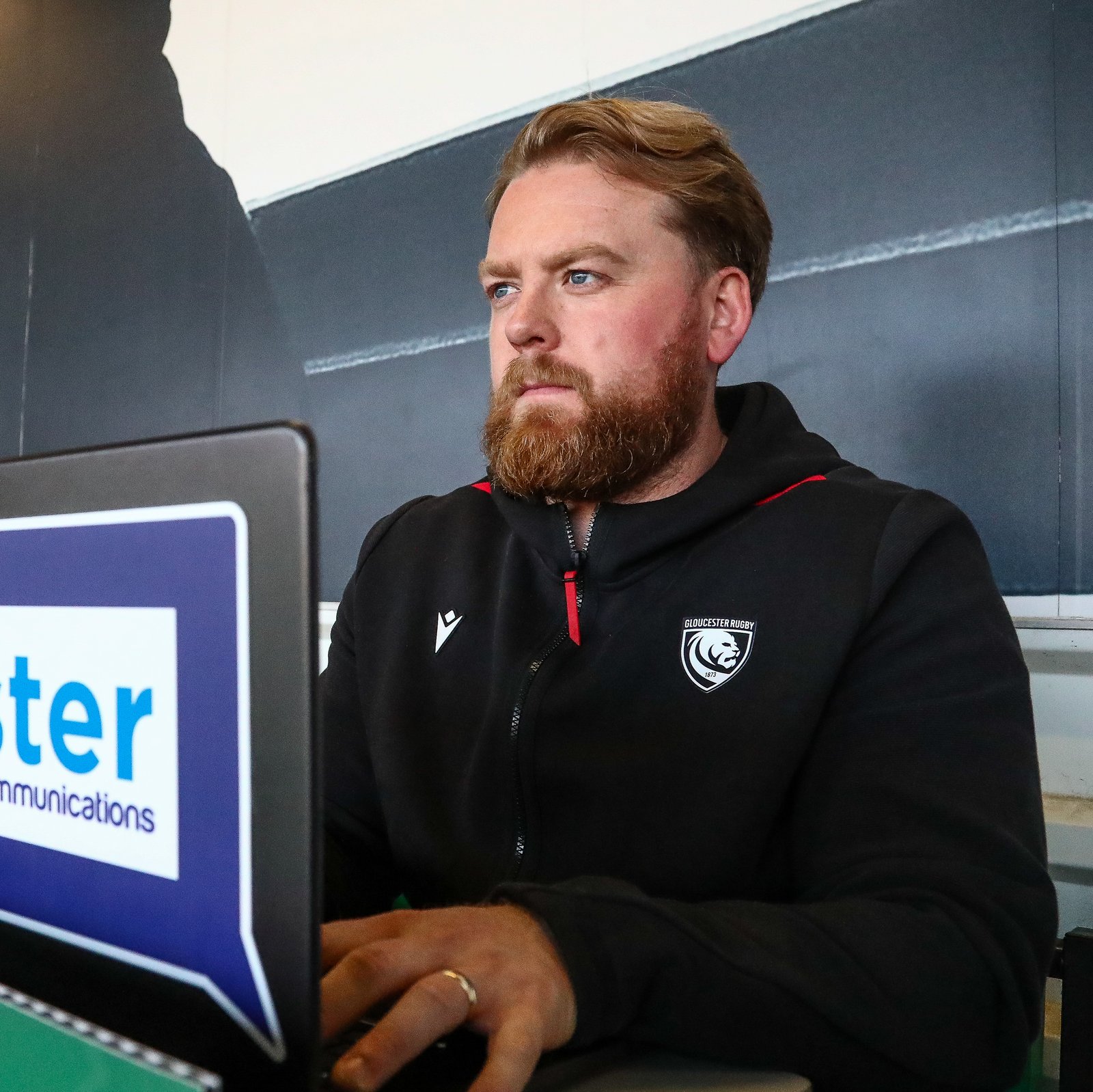
Tom Reynolds, Gloucester Rugby’s Head of Performance Analysis, at work on a match day.
Gloucester only began working with Axon in the summer. Reynolds got in touch with Axon after seeing the company announce its new AI layer.
“We had another video call and I was pretty blown away with the concept,” Reynolds admits.
“They weren’t too sure about the AI piece and were still considering using their Power BI reports for the next year, but quickly transitioned once they started using the AI layer,” adds Axon’s CEO and Founder Jon Foote.
Axon told Gloucester to take their time setting up. Reynolds and the club’s Technology Manager, Brett Ranford, spent two or three weeks working on it alone before the rest of the department joined.
“I was building templates to make sure that when the rest of my team joined onto it, everyone had a format, the right font, the right colour,” says Reynolds.
“Then they would know how we do a coach report, how we do a long-form report, how we do a summary page.”
Alongside the templates sit context files: plain-text documents, saved as .md files, that tell the AI how the department works and what each person wants from the report. Reynolds wrote one setting out his philosophy as head of department, as well as about the club’s approach to data and rugby.
“You go down a rabbit hole of, ‘What do I actually need to train this?’ And actually, it’s everything,” he says.
Each analyst now has their own file.
“The bot we’re talking to knows who it’s talking to, but there’s a bigger department one over the top of it.”
Reynolds has worked with Gloucester Head Coach George Skivington for six years and oversees a department of three people: two First-Team Analysts and an Academy analyst.
Originally, he planned to test the system in the background and fold it into the weekly preview and review process in February or March 2027, but was able to move forward much more quickly than that.
“We got two weeks in and we were like, ‘This is ready, this is good to go.’”

‘We’re AI now’ – the Axon story
Foote began his career in data visualisation in the pharmaceutical industry 20 years ago, then spent about a decade in data consulting for large companies and government.
About seven years ago that work took him to New Zealand Rugby, where the All Blacks and Super Rugby franchises were downloading their match data into Excel. He moved them onto a central data warehouse with Power BI reporting on top.
Through Super Rugby side the Highlanders, he met Andy Watts, who was also Japan’s analyst at the time, and they built the team the first “data warehouse as a service”. Watts joined Axon after the 2023 Rugby World Cup and is now their Product Lead.
The company’s clients include England, the Springboks, Georgia, Leinster and the British & Irish Lions in rugby union, as well as the Sydney Roosters in rugby league, and Peterborough United and the All Whites in football. Foote spun Axon out of his consulting firm in May 2025 and it opened a UK office the following September.
The biggest change came this February, when Foote saw a customer building reports as web pages from Excel spreadsheets with AI.
“I essentially went back to the team and said, ‘That’s it, everything else drops. We’re AI now, all in.’”
Axon’s system now works in three layers. First, the data comes in. Each club gets its own warehouse on Snowflake, a cloud data platform used widely in business, and Axon connects it to whatever suppliers the club already pays for.
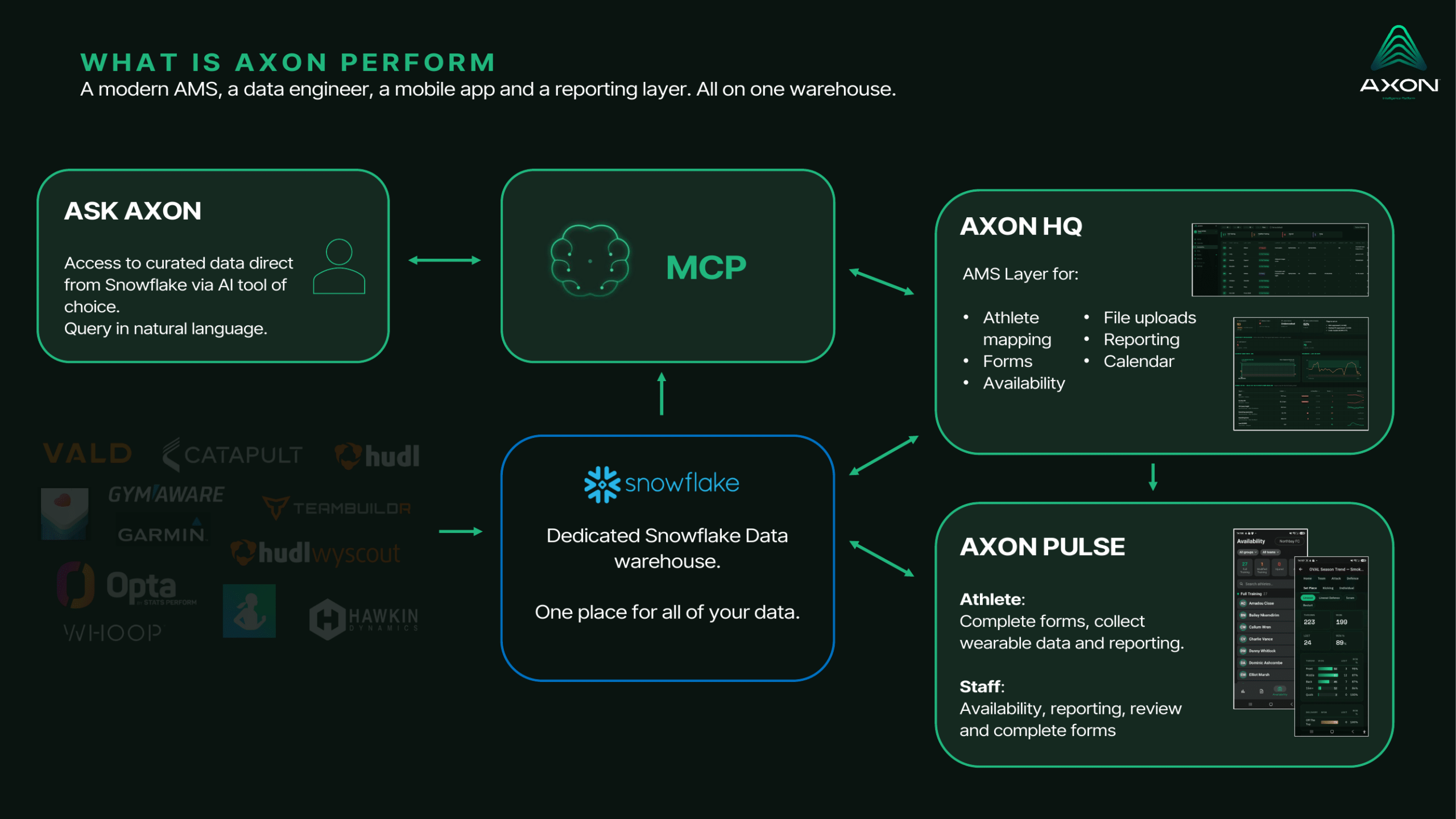
How Axon’s system fits together, from data suppliers to the Snowflake warehouse, the MCP layer, Axon HQ and the Axon Pulse app.
For Gloucester, that includes Oval Insights, Premiership Rugby’s official data provider.
“They come to us and say what data they want, whether that’s Oval or any other event or performance data, and we can get their API key, turn it on, and within a day they’ve got their data in the data environment, ready to be worked with,” Foote explains.
Axon HQ, the company’s web platform, maps each athlete to their record in all of their connected data sources. HQ has grown – at customers’ request – into a full athlete management system with forms, availability and a calendar.
The second layer is called an MCP, short for Model Context Protocol. It sits between the AI and warehouse and holds the definitions of every measure, so that when an analyst asks a question, the AI knows how each metric is calculated before it writes the query to fetch the data.
“Instead of an AI going straight to the data, and not really understanding every single column, what we’re getting now is a very high degree of accuracy,” Foote says.
The third layer is the reports. Axon supplies about 20 starter “skill files” – short sets of instructions covering rugby, football and performance reports, which clubs can then adapt.
Analysts work in VS Code, a free Microsoft program normally used by software developers, with Claude running inside it. Axon works with other AI models, but recommends Claude.
“It’s kind of like Windows Explorer, but on steroids,” Foote says. “You have a folder on your desktop that you connect to, and everything you do is in that folder.”

Gloucester’s two-week switch
Axon says it takes only 90 minutes to get an analyst from a standing start to building their first reports. At Gloucester, all of the design is done by the analysts in Claude.
“Axon now just holds all the reports,” Reynolds says. “They’re just teaching us how to use it, and they just want us to run with it. They just say, go and play, go and work it out.”
The clearest change for Reynolds is time. He recently asked the system for a study of winning indicators across all 93 Gallagher PREM games from last season.
Previously, this could have taken a month, but with Axon, he did it in “probably 20 minutes” and “had a report and the information to go and dig deeper and deeper.”
Each week, Gloucester’s analysts produce attack, defence and set-piece previews, plus a summary of top-line data. A few weeks ago Reynolds discovered that he could ask for all of this on one page.
“I just said, ‘Put all of those 30 pages onto one page for me.’”
That page now goes to the coaches first. Skivington reads it without needing to go into the detail of every unit.
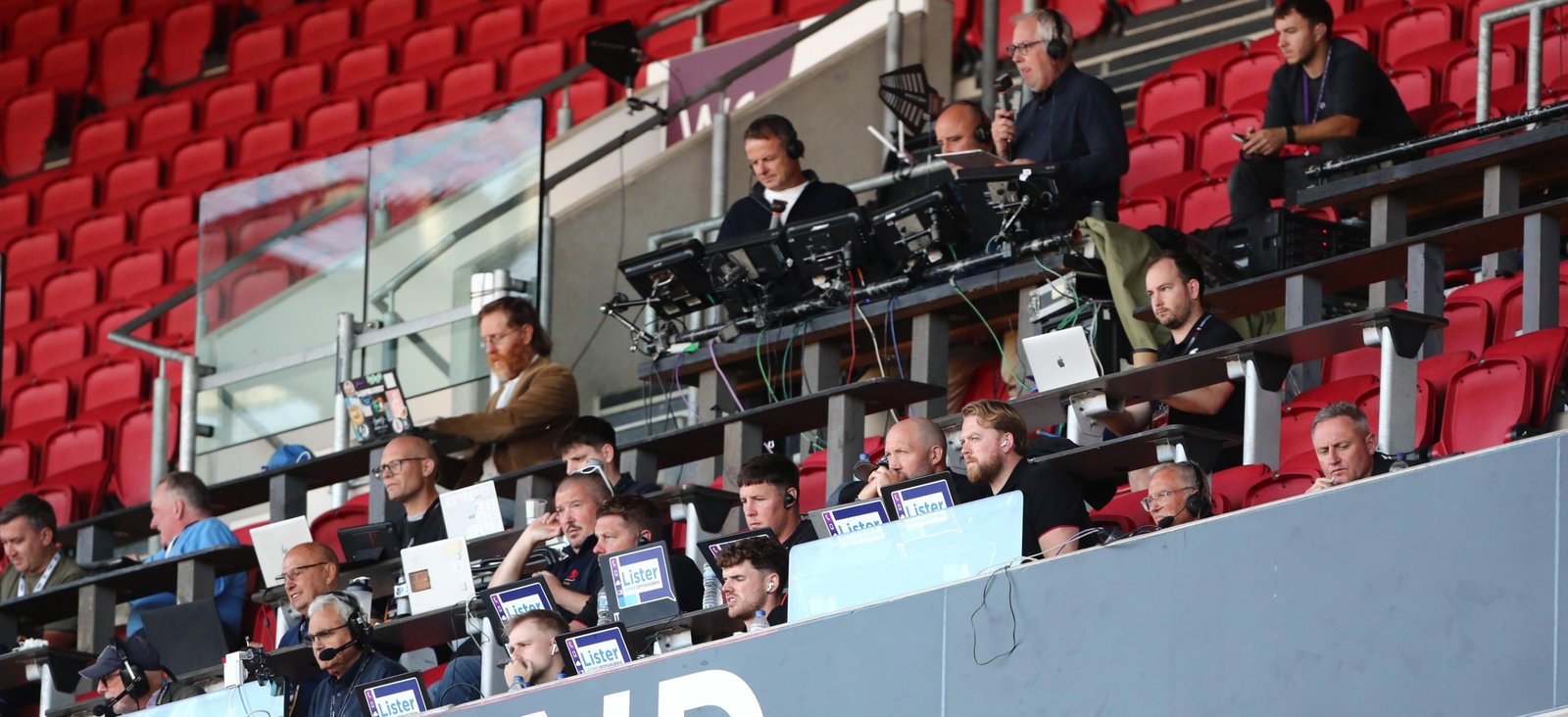
Reynolds sits alongside Head Coach George Skivington in the gantry during a match.
The analysts open each coaches’ meeting with a view of the opponent – ‘this is their DNA, this is how the game is likely to go.’
Reynolds believes the work has given Gloucester “the strongest game model and understanding of how we’re trying to play statistically” they have ever had.
The time saved goes back into watching games. Before facing Northampton Saints, the reigning champions, last weekend, Reynolds went back to find the last game in which a side had pushed them close at home.
“I have that time, because the data’s been churned out, the report’s been done and everything’s ready,” he says. “I’m not feet up, ‘right, my report’s done’, on a Thursday, but it’s allowing me to go, ‘I have more time, let’s watch another game, let’s find another project.’
“I need to watch the games and have my gut feelings, and then go and check the data and be like, ‘Actually, I was right,’ or ‘I didn’t think about that, let’s go and watch that again.’ It needs to be a sidecar to the actual preview and review.”
The coaches set the order of priorities.
Everyone says AI is going to take over - it's not.
Tom Reynolds, Gloucester Rugby
“The coach is not going to go, ‘What data have you got?’ He’s going to go, ‘What have you seen?’”
Reynolds describes his job as being a filter.
“I have everything, I need to see everything, I need to understand everything, but also I understand our game model, how our coaches coach, how our players want to play. There’s no point in me throwing 17 different numbers at Joel, because it’s not going to help anything.”
Each coach gets something different. Forwards Coach Brett Deacon, who joined from Leicester Tigers in the summer, wants more numbers.
“He worked with Steve Borthwick at Leicester, and traditionally that is a very data-heavy coaching group,” Reynolds says. “In contrast, Joel doesn’t need that much of the data. He wants to know what I’m seeing.”
Tomkins is a dual-code international who won three England caps in union while at Saracens, and joined Gloucester from Catalans Dragons, where he was Head Coach. In his first week, the coaches showed him a stack of creative tap-penalty moves from close range.
“Joel was like, ‘Well, I don’t know what they’re going to do, so what’s the 70% play? They’re going to run at you directly, so let’s just stop that and then we’ll deal with the rest.'”
Next steps
The next step for Gloucester is to publish reports live in Axon HQ instead of sending PDFs. Coaches will then be able to hover over a figure for more detail or switch between games.
Further ahead, Reynolds wants every data source in the playing department to be in one place. He uses the example of a kick chase.
“I know that’s an effective kick chase, but currently I can’t say, ‘What were the running metrics and the accelerations of these six players?’ I have to go and speak to the GPS analyst for that.”
On the British & Irish Lions’ 2025 tour of Australia, Axon combined the squad’s Catapult GPS data with match event data to show the direction and speed of players at kick-offs and in kick chases. Rugby has no optical tracking data of the kind that football now uses, so GPS is the closest substitute.
Axon’s mobile app, Axon Pulse, also pulls players’ sleep and activity data from whatever wearable they own, by reading what their device already syncs to Apple Health or Android’s Health Connect.
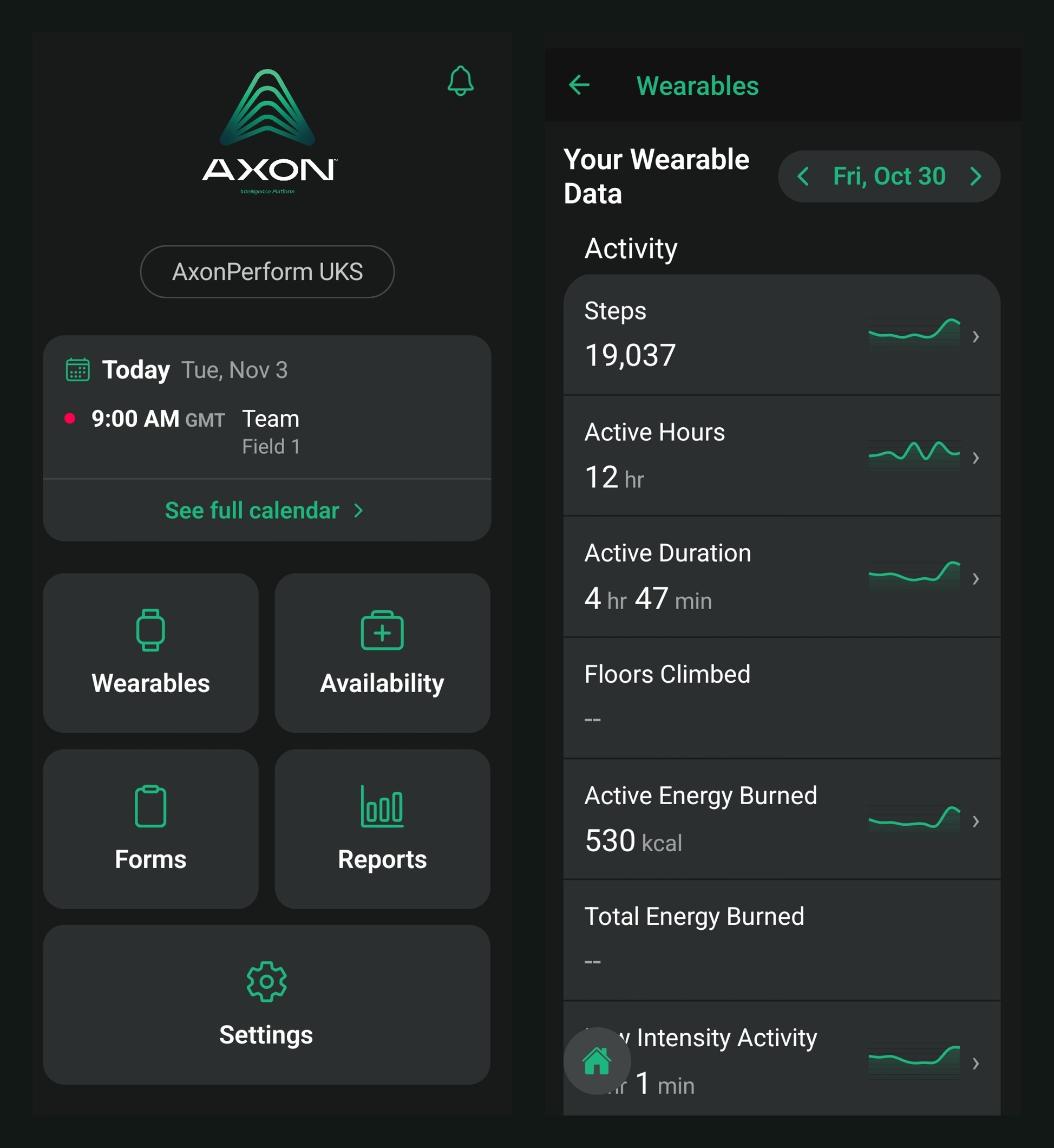
The Axon Pulse app, where players log forms and their wearable data is collected for staff.
However, Foote is wary of data for data’s sake.
“There’s so much data out there, you’ve always got to make sure that you’re not just using data for data’s sake, but it’s got an outcome, it’s actually going to make a difference on the field.”
For Reynolds, none of this fundamentally changes what his job is.
“It all comes down to people. I need to understand my Head Coach, I need to understand my Defence Coach. What do they actually want?
“Everyone says AI is going to take over. It’s not. AI is great, it’s a great assistant for me and for our group, but ultimately it can’t talk to a coach, it can’t understand what that coach needs in that moment.”
To arrange a conversation about Axon Perform, email Jon Foote at jon.foote@axonperform.com or visit axonperform.com
Follow Us
For latest updates, follow us on X at @ground_guru