79
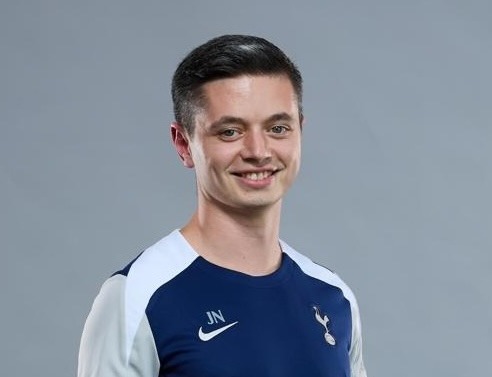
Joe Newton
From Brentford to Tottenham - Life as a First-Team Analyst
June 25, 2026
Our guest on Episode #79 of the TGG Podcast, in association with Genius Sports, is Joe Newton.
Joe followed Thomas Frank from Brentford to Tottenham last summer, swapping a six-year stint as First Team Analyst for a new role as Coach-Analyst.
In this honest and reflective episode, he opens up on where things went wrong at Spurs, mounts a passionate defence of Frank, and explains why Brentford keep punching above their weight even as they lose staff and players every year.
He also charts his own journey, from the Tranmere Academy to the Premier League, and reveals what really happens behind the scenes on an analyst’s matchweek.
What have you been up to since Tottenham?
Joe Newton: Obviously, when the season’s going and fixtures are coming thick and fast, it’s intense, and you can go longer periods without any days off. Depending on the fixture schedule, you could be in for more than 14 days straight, for example.
Obviously the off season speaks for itself. And if you go out of Cup competitions, maybe you get a free weekend and the coaches or staff try and utilise that as a sort of refresh period and recover – for not just players but staff as well.
It’s difficult in that sense because it’s hard to plan stuff really. It can come at short notice when those days off are going to come. So you don’t tend to plan anything in the season, maybe more around international breaks and then the off-season in the summer.
You know, nine times out of 10 in a European season you’re going to get June off. So you try and cram your holidays in June basically.
Getting started in football
It seems crazy to go back to this, but my journey in football probably starts when I was about eight or nine-years-old. I started off, like everyone, wanting to be a player and was fortunate enough to be at Tranmere Rovers Academy for nine years.
I went all the way through to get my scholarship, so 16 to 18 I was in full-time football as a scholar and then pro decisions came when I turned 18 or the end of that scholarship.
I didn’t get a pro (contract) at Tranmere and then I moved to Wrexham, to quite a unique scheme, where you were assigned as a professional footballer at Wrexham but also had the opportunity to do a degree alongside that at Wrexham University, at Glyndwr it was formerly known, Wrexham Uni now.
That was the perfect balance and transition for me, because I wasn’t arrogant enough to think, ‘I’m going to make it as a footballer.’
By the time the decision came at Tranmere, I knew I wasn’t going to get a pro contract, but I still wanted to give it a good go at whatever level I could. And Wrexham was a good level at that point, the National League.
It wasn’t something that lasted a long time – I think my age group were the first and I think there was only one other after that – but it wasn’t done in the quite the same way.
There was a lot more buy-in and excitement around it for the first year, which was my group, and I’ve talked already about being fortunate enough to land on that.
And yeah, I’ll compare it to an American scholarship scheme, because I had opportunities when I came out of Tranmere, when I knew my time there was coming to an end. I had scholarship offers to go over to America.
It’s crazy, because if there was someone else in my age group at Tranmere that wanted to do the same and we had a similar offer, I think we’d have gone together. A couple of lads in the year above us had done that but, ultimately, because it was just me, I was wanting to stay in this country.
And then this opportunity came about and it was led by Lee Jones, former player, and Adam Owen, who’s well known in the sports science industry. They were alongside each other running this scheme and introducing it to us.
And obviously it wasn’t far from me, from Tranmere. We played Wrexham quite a lot and there were people at Wrexham that knew about me and the squad at Tranmere and I remember Lee actually came in to deliver and sell it and what it was going to be.
And then it was an application process and I got an offer to join it and the rest is history.
It was a unique thing, because there was almost like a full squad of us doing this scheme. We trained with the first team a lot and the Uni were good in terms of balancing and adapting the timetable so we could still train. We were training every day and then usually Uni in an afternoon.
I didn’t make a first-team appearance for Wrexham, but I played a few reserve games and went on loan to a few different teams, one in the Welsh Prem, a couple in the league the below the Welsh Prem, and some in the Evo Stick as it was called then, like Witton Albion and Colwyn Bay, who were in the English system at the time.
I had a student loan at that point – I’m still paying that off – but they paid us as part of the contract to be a footballer, basically.
I think it was probably quite difficult for Wrexham to deal with it, as the manager has his first-team squad, still had a youth team and then all of a sudden you get this group slotted in. As a manager, you’re probably thinking, ‘Where does this slot in for me? Where can I use them?’
Some of the lads did get opportunities, they made first-team appearances. And we trained with them often enough to try and make an impact and show ourselves.
But I imagine it being quite interesting or difficult at times for the manager at that point.
While I was at TNS, I was still playing semi pro, and the owner of TNS also had a team in the English system, FC Oswestry Town. So I ended my contract and they said, ‘You’re going to be TNS analyst when you finish your Masters, but you’re going to play for as well.’
I knew I wasn’t going to make it in football, but I was still trying to play at the highest level I could while pursuing my career in analysis.
It was only when I moved down south for the Brentford job that I properly stopped playing. Up until that point I was still playing semi pro.
I’m not saying I was a top player, but I do think it gives a different angle when you’ve played at a decent level, which I would consider I played at.
I think it just gives a different angle of what a player might be thinking; you might understand a little bit more of what he’s trying to do, the sort of technique he might be going for.
I can imagine that from a data point of view too, because you want to understand the data is showing or measuring what you actually want it to.
Joining Brentford
It was just a traditional job advert, through my CV. Fortunately enough, I got invited to produce a task and then ultimately went down to present it to Luke Stopforth, the Head of Analysis at the time, and a couple of the coaches.
Then a couple of weeks later I got a job offer on the phone. And it just went from there. The title was First Team Analyst, which was basically what I was doing throughout my time at Brentford. I just developed the role as much as I could and developed myself.
Luke and Brentford deserve a lot of credit for what I think was a very good interview process, because the task I was asked to do was exactly like the job I was going in for.
So although you might think TNS and Brentford is a big jump, confidence wise I’d already done the job for the interview.
And that’s exactly what it was. I got a brief – it was the Hull game against Brentford in the Championship, the opposition stuff – to debrief the game, focusing on certain areas.
And then there was a sub-task from the Assistant Manager, individual clips from Brian Riemer, and again that was exactly what I got into the role. So the bigger meeting debrief was team based to the all of the coaches and the whole squad and then you add these little sub-tasks with Assistant Managers or other coaches to clip up these individual clips.
So it deserves a lot of credit, because the interview process was almost identical to what I was going into.
Why Brentford are experts in staff development
I think it speaks for itself, in terms of the staff turnover.
I think that probably points to the sort of direction the staff go in when they get there, in terms of development. I think it’s a fantastic club and I’ve got nothing but good things to say about it.
The key thing for me is that everyone is pointing and working in the same direction. That’s the biggest thing.
I don’t think you’ll get anyone at Brentford who’s against the data, for example, because that’s the club.
I’ll just speak about Set Piece Analysts, for example.
In my six years, I worked with four different Set Piece Analysts. One moved on quite early on in my time there, just towards the end of my first Championship season. Then we got in Jack Wilson, who went on to Manchester City as Set Piece Analyst and he’s now transitioned to Set Piece Coach and had roles at Wolves and now Sparta Prague.
As Jack’s replacement we got Marc Orti Esteban – he deserves a lot of credit but also Brentford as a whole for the development of staff.
He came in off the back of an internship at Midtjylland, as a Set Piece Intern, and just developed himself. The club allowed that development and he’s now Set Piece Coach at New England Revolution in the MLS.
And then we got Billy Wright in from Norwich to replace him and again he just hit the ground running. If you told me tomorrow that he’s moved on to some amazing role, it wouldn’t surprise me.
That goes for anyone at Brentford, because they’re a fantastic group of staff that the club allow to develop really well. It’s a fantastic group that can go on to be anything they want, is my opinion.
Taking staff doesn’t take a culture
On a slightly bigger scale, we took quite a few (staff) to Tottenham, but we found that just because you take six, seven staff, whatever it was, that doesn’t automatically take the culture from Brentford to Tottenham.
Obviously we knew that, but it was evident when we got there and it’s probably what you call Brentford’s secret sauce, of why people from the outside think they are punching above their weight every season.
Because they’ll lose players, they’ll lose staff to bigger clubs, but they just manage to kick on again. And I think it’s because it’s the culture, the approach of everyone pointing in the same direction and working in that same way.
And that’s from the very top. The owner’s fantastic, the people below him, in terms of Lee (Dykes) and Phil (Giles), just brilliant. It’s that culture that I think drives them, as well as obviously top talented people in staff and players.
Thomas spoke about it a lot when he was there, in terms of the relationship he had with them. It just filters all the way down. Matthew (Benham, the owner) is someone you’ll see in the training ground quite often.
He’ll come into meetings. He came into mine once and I was like, ‘Oh my God.’ But he’s just approachable. You could have lunch with him in the kitchen area. He just seems like a normal guy to talk to, but obviously very, very intelligent.
And like you said, he knows football and data extremely well. And that just filters all the way down through the club.
(When was the meeting he sat in on?)
It was after a Cup game, I think we played Leyton Orient in the Carabao Cup.
So I was doing my debrief meeting for that and he came in about halfway through. I carried on presenting and then we were going back to back, because the Cup game must have been midweek from memory.
Josh was doing the opposition for the upcoming game at the weekend and I remember when Matt walked in and I’m presenting, I froze for probably a split second and then just carried on. Then I look back to Josh and you can see the colour come out of him for like a split second, because he realised, ‘Oh no, I’m presenting next and and Matt’s gonna be in here.’
Literally the same day, we had lunch with him, me and Josh, and he sat down with us and said he really enjoyed the meetings and thought they were really good.
I hope it wasn’t to assess me – I’d have felt under more pressure if I’d have thought it was that! My feeling was probably just so he felt involved and understood the process, the behind-the-scenes work.
He more often came into Thomas’s meetings with the players, that me or Josh would be Josh would be behind the laptop presenting and he’d be sat at the back and watch that. This one was the first time I’d experienced it where he’d come into our coaches’ analysis meetings as well.
But yeah, I think it was more to see the process of sort of discussions that we’d have in the meetings, basically.
It was quite common to see him at the training ground, whether that be out on the pitch watching training, whether it be walking around having lunch, coming into meetings.
I think that shows how well he knows football and wants to know his football club and how we worked at the time.
It also comes from Thomas – and probably Keith’s the same, based on what I know after working with him. They welcome that, they don’t mind him coming into those meetings. Probably some managers would think, ‘I don’t want the owner in here, we could be saying all sorts of stuff we don’t want him to hear.’
But that just shows again the sort of alignment the whole club has and how open the staff are, of having discussions with everyone, from the very top all the way to the bottom of the staff. It’s a really good club.
Obviously you acknowledge that he is the owner, but you don’t feel, ‘Oh my God, I can’t talk to him.’
You’re probably a bit more nervous speaking to him than say Josh, my Head of Analysis, who I was good mates with, but you can speak to people from the very top as well (at Brentford): you can email them, you can have open conversations with them.
Role progression at Brentford - helped by Genius Sports
My role and title was pretty much the same throughout my six years at Brentford. But there were things that I was always trying to develop, whether that be learning new skills like Tableau for example.
I remember self teaching myself that with YouTube videos, with Tableau forums. Data courses, I did a Google Analytics course.
But I think the biggest progression probably came from the club side, riding the wave of getting promoted. Moving to the Premier League, it’s different.
You get access to software providers, different platforms, different ways of capturing footage live. Championship, you’d have to film your own games, whereas Premier League, you can use the Hawkeye, or broadcast footage that’s distributed through the Hawkeye network.
So again, you’re progressing yourself by learning new ways of doing things at the high level. So although my role probably didn’t necessarily progress, the club did and then I was trying to add extra bits to my role.
Whether that be an extra bit of training analysis, whether that be a slightly different report. And then with the different platforms you then get access to in the Premier League, it opens up different possibilities.
We didn’t have tracking data in the Championship at my time at Brentford, but then as soon as we moved to the Premier League you could get access to that, because it’s a league-wide deal.
And we then signed up with Genius not long into our time in the Premier League with the Performance Studio and the merge of event and tracking data just adds another layer of things you can go into.
Instead of just your generic metrics, it adds another layer. Say runs behind a defence, when you’re in possession. If I really wanted to know that from a post-match point of view, how many times we did it, the only way in the Championship because of what we had access to would be for me to manually tag that.
And then that would be limited to just our games, because we just wouldn’t have the time to go through every Championship game.
But the beauty of Genius and the Performance Studio is that the tracking data does that for you and you can be really specific with it, you can add extra filters to give extra context, in terms of the minimum speed of the run for example, so it’s more like a sprint or an actual run rather than just standing behind the defenders.
If you were doing that manually in the Championship, you’d only have your data or a limited amount. Once you’ve got that metric in the Performance Studio, you can run that across the league, and see where you’re ranking against other teams.
It adds that extra layer of things that you can measure that are relevant.
Of course there’s the generic metrics you can use, but how much do they actually tell you?
You get so much more context with the tracking data, which adds how effective we are at something, it opens up that door.
I felt like I could use more complex metrics with the coaches, because they were more familiar with it. And then we can adapt that when we deliver to the players, or be really clear in what that metric actually means, just to make it really clear for them.
The coaches were really open to that and I think they welcomed the extra layer of things with the tracking data that we had available to us. Thomas was really open and he was keen to know – once we introduced him to some of these some of these metrics and stats – ‘Oh, where are we for that?’
Or he’d be checking the opposition report, where it would show a league table in certain metrics, so he’d not only be looking at where the upcoming opposition are but where we are in the league, not just compared to the upcoming opponent but to the rest of the league as well.
What does First Team Analyst role involve?
It tends to split into different roles, the first team analyst roles. I’ll speak about our department at Brentford, because that’s the topic we’re on at the moment.
So we had Josh Kirk, who’s the Head of Analysis, but he would focus on the opposition side. So he’d watch the opposition games, produce those meetings, and deliver that to the coaches around Monday afternoon or Tuesday morning, so that can be drip fed to the players in terms of training content and meeting content throughout the week leading up to that Saturday.
And then there was me, focusing on the post-match stuff, and we had a Set Piece Analyst who would focus on all set pieces, whether that be pre or post-match or live.
And then we had an Assistant Analyst, who would do a lot of the data reports and lead databasing of goals and chances and things like that and more ad hoc tasks if me, Josh, Billy, Mark or Jack were occupied with other things, so it just gave us that extra pair of hands.
Now I’ll talk about my week. So working off a Saturday to Saturday, we’d work the game live, all three of us, so the Set Piece Analyst, me and Josh, we’d deliver stuff at half time that would be either taken by ourselves, that we thought was necessary, but would also be radioed up from the bench.
So if there was anything that the coaches wanted, whether that be Thomas or any of the Assistants, they’d radio up and say, ‘We need to show that.’
Then after the game, that’s when my post-match process starts.
I’d try and get it done on the Saturday evening and then I actually had a day off on Sunday, but I’d always do at least a couple of hours and produce that meeting debrief and that would then be presented to the coaches Monday morning, first thing.
That then gets trimmed, sometimes quite quickly if it was a quick turnaround, to present to the players.
And then Tuesday, was when Josh would present to at least the coaches – it wouldn’t tend to be to the players at that point. So I found Tuesday to be the final day of debrief and just collating everything.
So that might be small unit meetings, defensive unit meetings, attacking unit meetings, individual meetings. Thomas would often come to me and say, ‘I need clips of this player doing this, this and this.’
Or if he’d had time to go back through the game, he might give me timings and say, ‘Clip these up for me’ and then I’d organise them in a way I felt best to present. Then we’d show them individually to players in meeting rooms, in the corridor, whatever it may be.
And I felt like by the end of Tuesday, that was the debrief side done. We’d usually be off Wednesday and then Thursday, Friday, was the tactical stuff of the pre match and opposition meetings.
My role then would be I’d make sure all my post-match stuff was databased properly and backed up; best practise databases made or added to; and then I’d be assisting Josh wherever I could, going out to watch the tactical 11v11 and getting those clips ready for if we wanted to show them in the afternoon or the next day.
And then pre match, before the game on the Saturday, the final meeting would be… Josh and Thomas to the players, they would highlight, ‘Okay, this is, example, what Chelsea do. They do this, they do this, they do this.’
Then the matchday meeting would be examples of previous games of us, not necessarily against Chelsea, but against other teams that play in a similar way to Chelsea, and say, ‘Right, we said that they do this and this is what we’re going to do to them.’
It’s that sort of positive reinforcement that you’ve done this before, images in their heads of, ‘This is what we need to do.’ And that could be from previous games, it could be from training that week, and then the players go to the stadium.
The very last touchpoint is when the team comes in and we talk about the individual players and what their key threats are, probably just reinforcing what’s already been mentioned in the week.
Going viral
Yeah, that was strange!
Because all the backroom staff, but analysts as well, they’re usually behind the camera, not in front of it. That’s probably how I prefer it to be, to be honest!
This piece, I think it was Sky Sports. They did a day in the life of Thomas Frank. I was aware they were coming in, but didn’t think they would be in our meeting!
The normal process was I’d be in early on a Monday, to finalise my meeting, make sure everything was working well in the meeting rooms, and Thomas and the coaches and the medical staff would have their meeting first and Thomas would come down the corridor into our office and say, ‘Right, we’re ready for you.’
That’s when I’d go in to present my debrief.
So I walk into the meeting room and there’s three cameras in there and I’m like, ‘What is going on?’ I definitely look more nervous than I would be in a normal meeting but, aside from that, the process, what you see in that video, is pretty much identical to what we do on a daily basis.
I had mates message me saying, ‘Is that what you actually do, like every week?’ Yeah. There was nothing on show for the cameras, that was the process.
I present then to the coaches and the other analysts and later on in the video you see me and Thomas sat in Thomas’s office and we’re creating that narrative and that story that we want the meeting to the players to show.
That could be a case of taking clips out, reordering clips to paint that story the best way we can. I think it was quite good for me, because it got some good feedback, but I think it was good for people on the outside too, to understand the process in that.
Like I say, that Monday can get hectic, because I’d go into the coaches at 8:15, 8:30, with discussions and everything. We could be in there an hour. Then Thomas and me want to get a quick bite of breakfast. Often I’d miss breakfast, because Thomas would just get a bowl of fruit or something and be sat in his office with me and we’d be trimming down the meeting, because time was tight.
Then we’d present to the players at quarter past, half ten, something like that. That process you see in that video, of me and Thomas sat in his office, trimming the meeting down, that can be quite intense, because you’re under time pressure to deliver to the players at a certain time.
The piece was quite eye opening for a few people, it was good.
Fans, understandably, are very results orientated. You could have the best performance of your season and lose by a flukey goal 2-1, but you’d go on Twitter, you go on Instagram, and it’s, ‘Terrible performance, how can we lose to them?’
But then you could scrape a 1-0 win against a poor team and you’ve played really poorly, but the fans are like, ‘Great win.’ But that’s just the way football often works, especially with fans, and understandably of course.
But in terms of building something longer term, performances are just as – if not more – important.
Thomas Frank taking him to Tottenham
He’d sort of half mentioned it. We’d be in a meeting and I’d do something and he’d go, ‘Oh Joe, this is why you can never leave me.’ So those kind of small hints.
And then obviously about a year ago, the call came saying he’d been offered the opportunity at Tottenham and he wanted to take me with him.
I wouldn’t say it’s a no brainer, because I’ve got nothing but good things to say about Brentford and I knew how much of a good thing I had there, but it was a fairly easy decision because of the situation I was in at Brentford.
I’d been there a number of years and my role had pretty much stayed the same, aside from me trying to develop it as much as I could.
Josh – fantastic analyst, fantastic guy – was making no sort of indications that he was moving on, which is fine, and that would have been my next logical step at the club, in terms of at least applying for the Head role if it came up.
And then obviously the opportunity on its own, regardless of all that – going to Tottenham with Thomas, with the others like Chris and Justin from Brentford – it was too good to turn down basically.
New title was Coach-Analyst. Did the role change?
Yes and no. It didn’t change in terms of I was still doing the post-match for Thomas and the coaches for every game, so that main bulk of my work stayed the same. In terms of day to to day, I’d say yes it did change.
I was based with the coaches – I was in coaches’ meetings, I was on the grass for every session basically, aside from maybe when it was smaller group stuff after a game, when I’d focus on spending time in the office and getting some work done, whether that be individual clips or databasing of chances or anything like that.
The main bulk of my work stayed the same but then day-to-day, in terms of being in them coaches’ meetings, being that contact with the coaches and that link between coaches and analysts, that was the biggest difference.
It was always something we discussed in the analysis office and I also mentioned to Thomas – that Thomas and the coaches would have these meetings and there wouldn’t be any analyst in there, to hear what they were talking about, to think about what they were talking about, to then maybe go away and say, ‘You know what you were talking about yesterday, I’ve actually got some data or clips to support that.’
And that was something I felt we could have done at Brentford and ultimately that’s what I ended up becoming at Tottenham for Thomas and the other coaches.
People think I actually coached. I didn’t. But that was just the way my my role was.
Mine was more of a link between the two. I probably define mine as being the eyes and ears of the coaches, so anything I saw or they were seeing, I could then relay back to the relevant people in the analysis department or I just did it myself.
These things that were discussed in meetings, I’d have my laptop there and could sometimes find it straight away, sometimes it was more of a bigger project that I needed to go away with, or liaise with the relevant people in the analysis department, whether that be data guys, whether that be opposition analysts, whether that be Set Piece Analyst, and go from there.
It’s becoming a more and more common title, but the title might, in terms of the role, be slightly different. If you come from more of a coaching background, you might be doing more on the grass than I did in terms of actual terms of actual coaching.
You might be setting up the opposition team and taking up that role of almost like a coach. We had Kev O’Connor, used to do it at Brentford, and work with Josh and say, ‘Right, in this phase, Arsenal are like this,’ and Kevin would be responsible for setting up that other team in training.
That could be the role of a Coach-Analyst going forward, because if they’ve done the analysis or work really closely with with the analyst, they know it from back to front. They can just go and implement the team and put it out there.
So, yeah, it will depend on the sort of background and how you got into that role of what it looks like. But that’s how it looked like for me and that’s how I could see it for others as well.
Scale and pressure of Tottenham
I think in I think in general, it would have been like that anyway. Obviously, just size of club, massive. And of course there was that but even personally, my name had been mentioned in terms of going with Thomas, so that got a bit of publicity, if you want to call it that.
When it was happening, that I was going to Tottenham, my phone was just blowing up, it was crazy. I never experienced anything like it. So that was completely different for me personally.
But even if I’d gone a bit more under the radar and no-one knew my name, I think the size of the club would have still stood out compared to Brentford.
Because my name was being mentioned, it just added another layer to that publicity and people noticing me. At the time, of course, when it was initially happening, it was exciting, it was good.
We started the season quite well and then it became more difficult, that sort of scrutiny.
Where did things go wrong at Tottenham? Lessons and learnings
Of course we weren’t perfect. There are things we will look back on now and say, ‘Oh, maybe we could have done that, maybe we could have done this.’ But I think that’s with hindsight.
The way we worked, the way Thomas works, we had so many meetings daily – coaches and me included in that – to discuss what training would look like, what the team might look like. And we’re getting all this information from medical, from all the coaches, their thoughts, and I’m convinced there wouldn’t be many decisions – taking hindsight out of it – that we would come to differently if we’re put in the same situation again.
We were making those decisions with what we felt was a good process, with all the information we needed.
From the outside, that might look, ‘Why the hell have you done that, that’s a crazy decision.’ But internally, with the information we had – ‘He’s struggling with this, he can’t play more than 50 minutes’ – I think it would be rare for us to come to a different decision.
We’re not perfect, I’m not I’m not saying that. And I think I said to you before coming on this call – for any manager going in, or any group of staff, they need time to implement things, to understand the players and what works for players. It was a completely different group compared to what we had at Brentford.
And that takes time. Early on, when we had a pre-season – even with it being disrupted, we were in Hong Kong, South Korea, they’re intense, little training time, and all these hurdles you have to overcome, then with the Super Cup final and the early part of the Premier League season was quite spread out, in terms of how it got when you throw in Champions League games as well – I felt we were actually onto something.
I mean, the results and performances speak for themself. In the early part of the season we started quite well.
And then ultimately it ends up catching up with you. When those Champions League games come you get injuries, you have to rotate the squad, because you’re going to get more injuries.
So it was rare that we’d play the same 11 back to back because of that situation. And then that’s harder for the players, it’s harder for you, because players can’t then build relationships, because you’ve got to swap that player, swap that player.
Ultimately that ended up catching up with us, with injuries, burnout and (not) being able to reproduce performance levels. We’d have some really good performances, really good games, and then we’d come to the Tuesday game or the following Saturday after a good game in the Champions League – because we did well in the Champions League – and you could see that we just couldn’t get going.
And that’s also the staff. I’d be up till God knows what time on a Tuesday or Wednesday debriefing the Champions League games, 4am, in the next day. It eventually catches up with you when you’re doing that.
However many times we had to do it in the season, with Cup games as well, it ends up catching up with you and I would say that’s what ultimately happened. You lose that time to implement ideas, to train, to understand the players and what works for them from a training point of view and from a scheduling point of view as well.
All of those things contribute to what happened. It just ends up catching up with you; it’s just a ball that keeps rolling.
I remember we got to January I think, and we had a free week. And when I say a free week, I mean like a weekend to a weekend, so we had no midweek game.
And it was something like the first time since August that we’d had that. Of course you’ve got to play games, but when you’re a new group of staff learning a new group of players, if you just had two or three more of those in a season, it’d make the world of difference.
Even when there was a patch of of games when things weren’t looking great, internally there was a feeling we were onto something, we were getting somewhere.
We weren’t getting battered. I know we got beat by Arsenal quite convincingly, but that was just a real bad day, bad performance.
We went through a spell where we might have lost a few games, but they were by one goal. And it’s just that feeling of needing a little bit of luck sometimes.
Bournemouth away – especially second half, we played a really good game. My opinion was there was only one team that was going to win that game, but the footballing gods just had to write a story that it was Semenyo’s last game before going to his medical for Man City the next day and 94th minute he had to score the winner to make it 3-2.
At that point you’re just like, ‘Oh my God, everything’s going against us.’
But of course there’s things within that that you can affect. But I’m convinced that if just a couple of games went differently, and instead of losing we got a point, then it’s a completely different story.
But those are the fine margins I suppose.
Did the style of play change from Brentford to Tottenham?
No, I mean ideally it wouldn’t have. I think there were probably moments when we thought, ‘We can’t do that here,’ or it could be dependent on personnel or on the capability of a player.
Throughout a good chunk of the time we were there, we had Destiny Udogie injured, so playing Jed Spence left back, just one example, throws a little spanner in the works, because he’s right-footed.
So that can limit how you build up, or your options within building up. You need time – whether that be meetings, whether that be training – to get ideas, principles, style of play across.
Because of the number of games, we didn’t really have that.
And it was hard to get those things across. That’s where I think it probably worked in pre-season, because we had more of a focus towards the Super Cup.
We were playing PSG and basically got the defensive stuff nailed, or we tried to get it nailed, that was our focus in pre-season. In the the early games you can see that we were good defensively, and then as the season went on we were trying to drip feed in the attacking points.
But the time was limited and then sometimes it’s too late.
In defence of Thomas Frank
Firstly, to answer the first part the first part of the question, he’s such a top, top guy. Obviously a top coach, even though some from the outside will say, ‘Oh well, he failed at Tottenham, so he’s not a good coach.’
But I would tell them they’re lying. He’s done a number of years at Brentford and we achieved some amazing things considering the club.
And that was obviously down to him in terms of what he built culture-wise at Brentford, which is still living on now I think. Obviously Keith has added to that in his own way and I think he will thank Thomas for what he did in terms of building that culture.
And Thomas takes a lot of credit for that and that is the type of person Thomas is – just a good, good guy, really good to work with.
Obviously, like you’d imagine in high-end sport, it can be demanding at times. I’ll get phone calls at certain times of the day, I’ll get voice notes, I’ll get messages.
‘Can you look into this? Can you look into that?’ And of course that’s just the way it is, that’s what being an analyst is sometimes, or just working in football in general.
He’s a very open person. Like I mentioned earlier, with all these coaches’ meetings, he would welcome other people saying what they think.
And I think that makes him so good, because he’s not arrogant enough to say oh my way is the only way. And he might not take that advice, he might not take that view, but he’s open enough to listen to it.
And I think he’s said he’s not going in the summer, he doesn’t feel it’s the right time, but I think that openness also shows in the shows in the statement, where he said I want to go away to other sport, to other organisations, and see what I can learn and study basically, and come back a better version of himself.
And I think again, that just sort of sums him up as a person, he’s always looking to develop and that’s where that openness comes from, because he wants to learn. And that’s why I enjoyed working with him so much, because although I would say I’m just an analyst, I felt comfortable enough to say what I thought.
And sometimes Thomas would go, ‘oh, Joe, I don’t agree.’ But I’d rather feel comfortable in saying stuff and then him disagreeing than me not feeling comfortable to say it at all.
And that’s just him as a person.
Ambitions for the future
Hopefully stay in analysis, of course, and at the highest level that I can and whatever opportunity comes in hopefully the next few months.
And just keep working, keep developing myself. I think longer term I have – I know you’ve had guys speaking at the conference and stuff that have done this course – the Sporting Director course.
I think that’s something further down the line I’d love to go into and I’m gonna look into that course and see whathat could sort of look like. look like. But, yeah, that’s me really.
I want to go back to not being under the radar but just getting on with my job as an analyst again. I’ve had the time now where I’ve been able to sort of debrief things in my head and make a few notes and things. Now I’m ready to get back in basically into a club.
I’m looking forward to it and I’m excited.
This content is for TGG Members
Join up today and get access to:
- All articles: news, interviews, analysis
- Masterclasses & Online Conferences
- Full Academy Productivity Rankings
- Club Directory: 1,000+ staff profiles
- Personal Profile Builder
- TGG Live 2024 & 2025 presentations