
Why the fastest recruitment departments are winning the transfer market
Written by
Hudl Statsbomb
September 16, 2026
The big question facing recruitment departments today is not whether they have enough data, because they almost certainly do.
A modern professional club generates somewhere between 18 and 22 million structured data points every single week, according to Hudl. Those data points span GPS and optical tracking, video, tactical events, medical records, and scouting activity.
Alongside that sits more than 100 hours of match and training footage.
TGG Members are able to watch all seven presentations (including Brad Pryjmachuk’s) from the 2026 Scouting & Recruitment Webinar. To find out how to become a TGG Member, click below.
The big question is really whether organisations have the infrastructure to turn that volume into something a decision-maker can act on, before the window closes, before a rival makes their move, before the moment passes.
Brad Pryjmachuk (pictured) has spent more than 15 years working in professional sport, including as Head of Analytical Solutions for City Football Group. In his current role as Senior Manager of Customer Solutions at Hudl he works with clubs across the globe navigating exactly this challenge.
Speaking at TGG’s 2026 Scouting & Recruitment Webinar, Pryjmachuk set out the structural reasons why so many recruitment departments are falling short, and what it looks like when they get it right.
The fundamental challenge in most recruitment departments isn’t a lack of talent or ambition, it is structural. Scouts and analysts are caught in a cycle of manual, repetitive work that consumes the hours they would otherwise spend on higher-value activity.
Collecting and reconciling data from multiple systems; rebuilding the same filters and playlists across disconnected tools; writing individual player reports from scratch; fielding reactive requests from Sporting Directors and Heads of Recruitment.
“These are genuine challenges and time-consuming processes we see with our customers,” Pryjmachuk said.
They also represent a significant drag on the quality and speed of decision-making. The cost might not always be visible, but consider what gets crowded out: proactive long-list building, consistent player tracking across a full season, early identification of market opportunities before prices rise.
The role of AI
Artificial Intelligence has genuine utility in this context, not as a replacement for the expert eye but as a mechanism to scale it.
The most immediate application is in player reporting, a problem Pryjmachuk hears about constantly from clubs across the world.
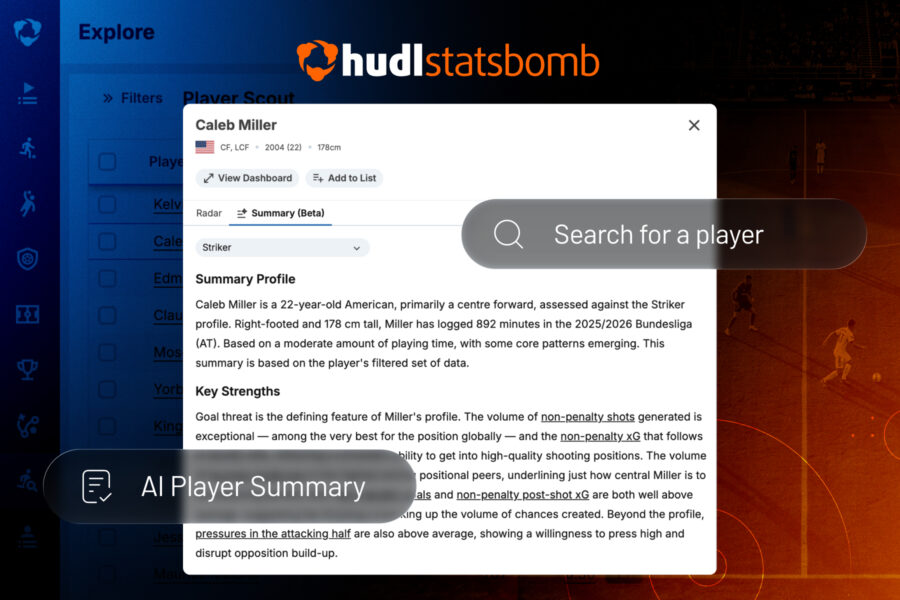
Teams already have access to the deepest data in football. But the problem has never been the data. It has been everything it takes to turn a player’s numbers into something you can act on: the querying, the scanning, the write-up before a shortlist even gets discussed. AI Player Summaries in Hudl Statsbomb cut that part out. Find out more by clicking below.
“Traditionally, scouts spend hours writing reports on players, or Sporting Directors ask questions like, ‘Do we have a summary of X player for the board meeting?’
“And as we hear from our customers, the answer the majority of the time is no.”
Hudl’s response is an AI-generated player summary, built into the Statsbomb platform, that automates that process.
“We’re enabling customers to translate pre-selected data into a structured narrative highlighting key strengths, weaknesses, and a stylistic fit,” Pryjmachuk said.
“This will provide immediate, contextualised evidence and significantly reduce the time spent in the player discovery phase.”
In practice, the tool generates an overall player profile against a customisable position template, highlights key strengths and areas of concern, and links each directly to supporting video clips. This means a scout can move from a statistical flag to actual footage in seconds rather than hours.
“Something that may have taken a few days or a few hours to pull all this information together is now done with a number of clicks,” Pryjmachuk says.
Two benefits stand out:
- Speed: Getting a credible read on a player in seconds rather than hours doesn’t just save time, it changes what is possible within a given window. This means more players assessed, more opportunities spotted, more decisions made with confidence.
- Consistency: When every player summary is built on the same framework, the quality of analysis no longer varies with workload, time of year, or who in the department is under the most pressure. That consistency matters especially for smaller departments, where the gap between what needs to be assessed and what can realistically be covered is most acute.
Case study: Cardiff City
Cardiff City are among the clubs already using it.
Ben Pickford, their Senior Technical Scout, says: “We have purposely designed a lean recruitment department structure at Cardiff City, so the ability to move with pace and agility is huge for us.
“As part of that, we are always looking at ways to reduce time to insight for our technical scouts and decision makers.
“The introduction of the AI player overview has proved excellent in achieving this for us when exploring prospective players. Providing precise and objective reports, the overview creates digestible intelligence which allows our scouts to act faster.
“Coupled with the ability to narrow in on super strengths and areas of improvement through direct links to video, we have accelerated our ability to provide high-quality video outputs to present to coaching staff.”
Cardiff were the highest-ranked Category Two academy in TGG’s recent Academy Productivity Rankings, finishing 16th of 89 clubs.
None of the above changes the fundamentals of good recruitment though.
Judgement, context, relationships, and an understanding of a player as a person rather than a dataset will always be irreplaceable. What AI changes is the infrastructure around those judgements, clearing away the manual overhead so that the people best placed to make high-quality decisions are spending more of their time doing exactly that.
Follow Us
For latest updates, follow us on X at @ground_guru