
Gemini Sports: How clubs build a collaborative scouting workspace
Written by
Gemini Sports
April 22, 2026
Modern football recruitment is no longer the domain of a single chief scout with a little black book.
Today’s sporting departments are complex, cross-functional operations involving sporting directors, scouts, data analysts, coaches, sports scientists, medical staff – all of whom need to contribute to, and draw from, a shared intelligence base.
The clubs that win transfer windows are the ones whose entire recruitment team operates from a single source of truth, with seamless collaboration baked into every step of the scouting pipeline.
This white paper examines the operational challenges clubs face when building a collaborative scouting workspace, the pitfalls of fragmented in-house solutions, and how a purpose-built platform — like Gemini Sports — enables clubs to focus their domain experts on what they do best: finding and developing talent.

The Problem: Fragmented Scouting Operations
Most football clubs, even at the elite level, struggle with a scouting workflow that looks something like this:
A chief scout maintains spreadsheets of player targets. An analyst pulls data from StatsBomb or Wyscout into a separate dashboard. A data scientist builds a custom model in Python that lives on their laptop. A sporting director receives PDF reports by email. Coaches share opinions in meetings that are never systematically recorded.
The result is a recruitment operation that is fragmented by default. Information lives in silos. Conversations happen in corridors and are lost. When a scout leaves, their knowledge walks out of the door with them. When a transfer window opens, the club scrambles to reconcile competing lists and conflicting opinions into a coherent strategy.
This fragmentation creates three core problems:
First, there is no single source of truth. Different stakeholders reference different data, different player lists and different evaluation criteria. A scout’s shortlist may exist independently of an analyst’s model output and neither maps cleanly on to the sporting director’s strategic priorities.
Second, collaboration is manual and asynchronous. Sharing a scouting insight requires sending an email, scheduling a meeting, or updating a spreadsheet — none of which happen in real time and none of which create a persistent, searchable record that the entire team can access.
Third, institutional knowledge is perishable. When evaluations, reports and notes are scattered across personal drives, email threads, and physical notebooks, they disappear when staff turn over. A club’s collective scouting intelligence should be a durable organisational asset, not a collection of individual memories.
Problems with building in-house
Many clubs attempt to solve this problem by building their own tools and software solution. The logic is intuitive.
“We have data scientists and analysts. We understand our own workflow. We’ll build a custom dashboard.”
This approach almost always fails for reasons that have nothing to do with the initial build and everything to do with ongoing maintenance. Building analytics software means taking your best data scientists and turning them into software engineers debugging dashboard loading times.
Or it means hiring expensive software developers who don’t understand football to build tools for people who do. The maintenance burden is brutal. Your Wyscout API breaks. StatsBomb changes their data structure. SkillCorner updates their tracking metrics. Your homegrown system needs constant updates while delivering zero competitive advantage in recruitment.
No technical director wants three data scientists spending 40% of their time on software maintenance instead of scouting analysis. At £100,000 per data scientist, that is over £120,000 per year in salary costs producing infrastructure instead of insights. AI makes custom dashboards cheaper to build. It does not make them cheaper to maintain.
It does not fix broken APIs at 2am. It does not retrain your recruitment team when the UI changes. The clubs that thrive are the ones that recognize a critical distinction: the competitive advantage is not in the software: it is in the football intelligence that the software enables.
The foundation of any scouting workspace is a single, comprehensive player database that integrates data from every source the club uses.
Genius Sports
The anatomy of a collaborative scouting workspace
A truly collaborative scouting workspace must serve every stakeholder in the recruitment pipeline, from the scout watching a match in Brazil to the Sporting Director presenting to the board. It must be built around five interconnected capabilities.
1. Unified Player Intelligence
The foundation of any scouting workspace is a single, comprehensive player database that integrates data from every source the club uses. This means event data from providers like StatsBomb, tracking data from SkillCorner, market valuations, scouting reports, physical data – all mapped to a single player identity.
This is a harder problem than it sounds. Different providers use different IDs, different naming conventions and different schema structures. A player might be “Mohammed Abu Al Shamat” in one system and “M. Abu Al-Shamat” in another. Without robust ID mapping across providers, clubs end up with fragmented records and duplicated work.
Gemini Sports solves this with a universal entity mapping layer that maintains cross-references to every major data provider. This means a scout, an analyst, and a sporting director are always looking at the same player, with the same data, regardless of which provider originally sourced it.
2. Shared evaluation frameworks
Raw data is necessary but not sufficient for recruitment decisions. Clubs need shared metrics and evaluation frameworks that translate complex statistical outputs into language the entire scouting team can understand and act on.
This is where proprietary rating systems become essential. Gemini Sports provides core metrics such as GPR (Gemini Player Rating) – a question every sporting director needs answered: “How good is this player, really?” It provides a single number that is comparable across leagues.
It also provides scores for attributes of a player such as: passing, shooting, carrying, etc and also fit to a certain positional profile. Gemini Sports also provide a valuation model based on performance alone to provide a benchmark to recruitment teams for if they are getting value for their money from the price demands by other club.
Critically, Gemini Sports does not force clubs to abandon their own analytical IP. The platform is designed so that a club’s proprietary metrics, may they be custom possession value models, pressing intensity calculations, or even bespoke injury risk algorithms that can live inside the platform alongside industry-standard data. Clubs are not choosing between their own competitive intelligence and robust infrastructure. They get both.
3. Big boards – recruitment pipeline management
Identifying talented players is only the first step. Managing a recruitment pipeline by tracking which players are at which stage of evaluation, who has been scouted live, who needs a deeper analytical dive, who is approaching contract expiry requires structured workflow tools that the entire team can access and update.
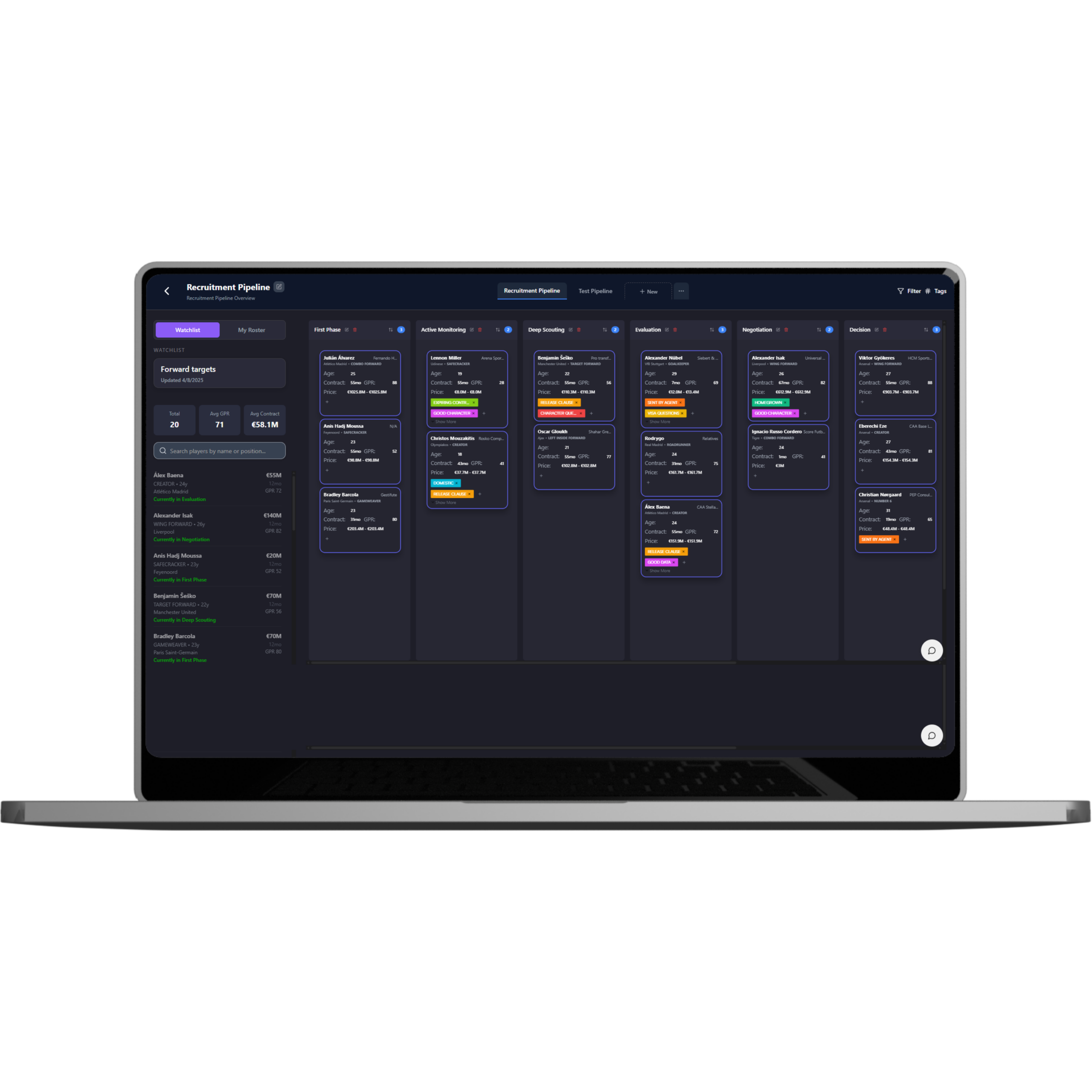
Gemini Sports provides this through Big Boards, a kanban-style recruitment pipeline that organises players through customisable stages: Discovery, Active Monitoring, Deep Scouting, Evaluation, and Negotiation. Big Boards serve as the central nervous system of a club’s recruitment operation.
For collaborative scouting, Big Boards solve a fundamental co-ordination problem: everyone on the recruitment team can see, in real time, the state of every target in the pipeline. There is no need to reconcile competing spreadsheets or chase email updates. A scout adds a player to the Discovery column. An analyst runs the numbers and adds a note. The Sporting Director reviews and promotes the player to Deep Scouting. The entire pipeline is visible to the team.
Each board can be shared across the scouting team with role-based permissions (Owner, Editor, Viewer), enabling Sporting Directors to set strategic direction while scouts and analysts contribute intelligence at every stage. Players can be tagged, categorised by priority, filtered by attributes (GPR, position, age, market value), and moved through the pipeline as the evaluation progresses.
4. Scouting Reports and Notes
Data-driven evaluation and subjective scouting judgement are not competing approaches. They are complementary. The best recruitment decisions happen when statistical profiles are enriched by first-hand observation. A collaborative workspace must make it easy to capture, organise and share qualitative scouting intelligence alongside quantitative metrics.
Gemini Sports integrates scouting reports and notes directly into player profiles. Reports can be match-specific or general assessments. Notes provide a lighter-weight mechanism for capturing observations, opinions, or flags such as “agent providing salary demands” or “willingness to move”. This is crucial information club has access to which should not live in someone’s head or need to be chased down in Whatsapp or via emails when a crucial decision needs to be made.
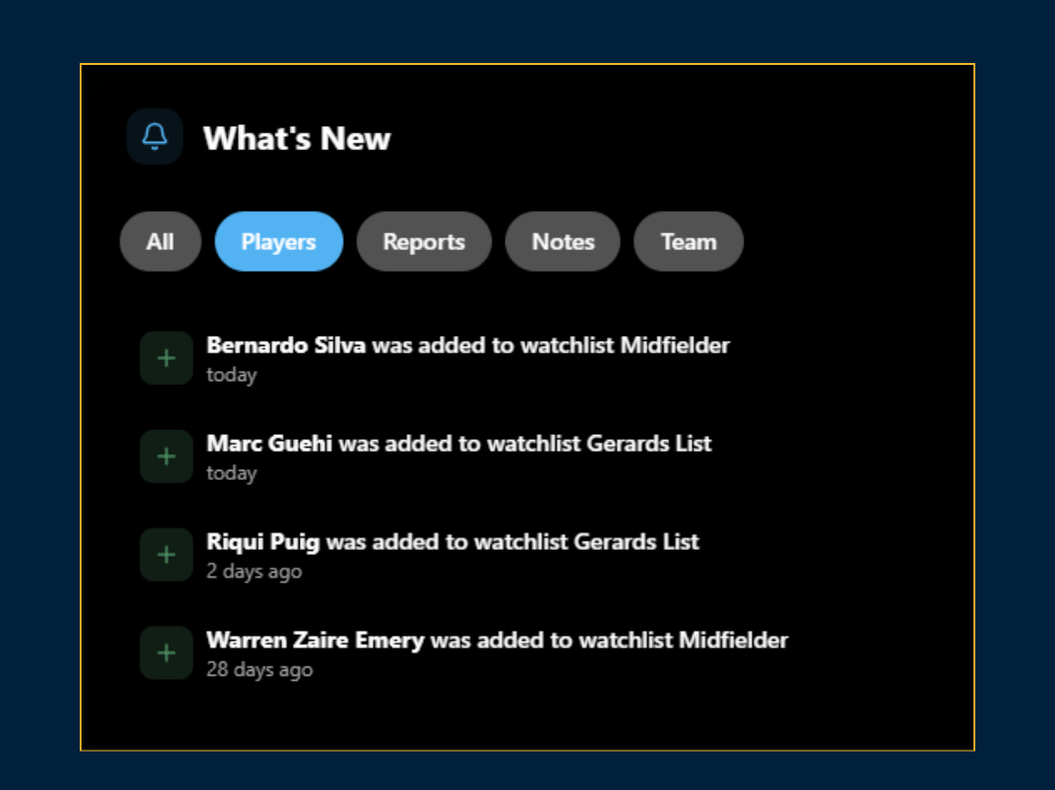
The activity feed (“What’s New”) aggregates all scouting activity across the organization – reports submitted, notes created, players added to watchlists. This creates ambient awareness: a Sporting Director glancing at their feed knows what their team has been working on without scheduling a single meeting.
5. AI-powered discovery and querying
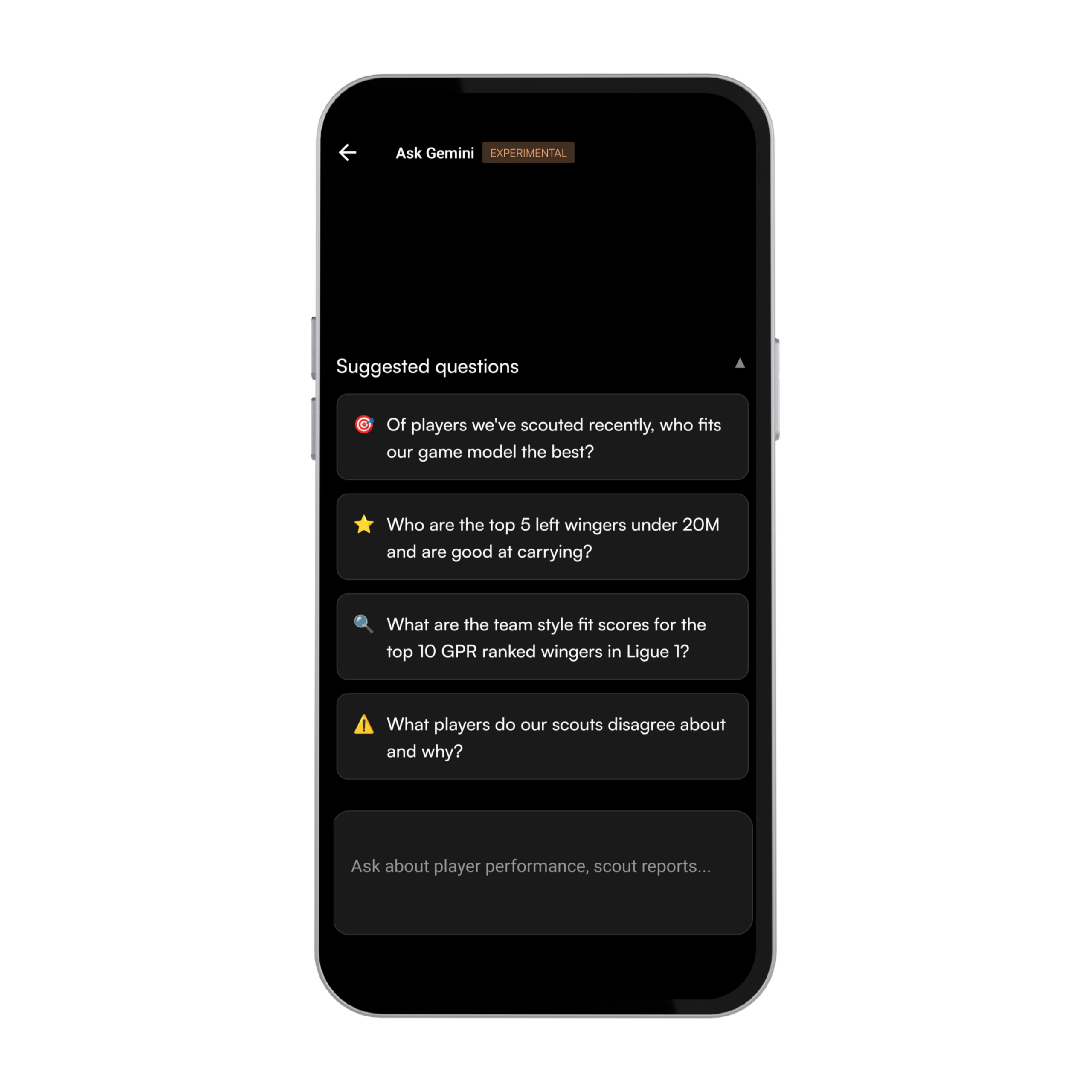
The final layer of a collaborative workspace is intelligent discovery, the ability to ask questions of your data in natural language and receive actionable answers. Traditional scouting tools require users to know which filters to apply, which metrics to sort by and where to look. AI-powered interfaces invert this: the user describes what they need and the system finds it.
Gemini Sports provides this through askGemini, an AI chat interface that allows any member of the team to query the platform’s entire database conversationally. A sporting director can ask “Show me left footed centre-backs over 6’2 that my scouts have written reports on.” and get results drawn from unified multi-provider data.
The platform also provides Recommended Players, surfacing position-filtered scouting targets based on the club’s squad profile, budget, current needs, and strategic priorities. These recommendations appear on the home screen and can be actioned immediately by adding players to a watchlist, keeping the scouting pipeline continuously fed with relevant targets.
How collaboration works in practice
To illustrate how these capabilities come together, consider a realistic scouting workflow on the Gemini Sports platform:
A Sporting Director identifies that the club needs a left winger capable of contributing both goals and progressive carries. He creates a Big Board called “Summer 26 — Left Wing” and shares it with the scouting team as a collaborative workspace.
An analyst uses Gemini Sport’s proprietary metrics, along with the club intelligence built by their data scientists and queries for players that fit their budget and match their playing style. A result of 30 candidates surfaces all of whom are added to a watchlist. The analyst writes their own opinions on the player as notes.
A scout based in South America recognises three names on the list. She files scouting reports against two of them from matches she attended last month, noting that one player’s off-ball movement is quite good, while another’s attitude concerns are worth flagging.
Another scout based in house wrote reports by watching videos from WyScout.
While the analysts and scouts were working, the sporting director received a crucial update for one of the players they were watching, that there is a release clause in the player’s contract that can be triggered. The Sporting Director makes a quick note of it – private to him so that it does not get leaked in the press.
Now it is time to present in the recruitment meeting that includes the board (for budget approval) and the manager for his opinions. The Sporting Director pulls up the Big Board, reviews the pipeline state, summarises the accumulated reports and notes, takes feedback from the manager and updates the pipeline status.
At no point did anyone send a spreadsheet by email. At no point did anyone ask “Where was that report you mentioned?” At no point did anyone reconcile conflicting data from different providers. The entire scouting process from initial identification to the meeting happened in one shared workspace.
The infrastructure behind collaboration
Collaboration at the interface level is only possible when the underlying data infrastructure is sound. This is where the build-vs-buy decision becomes most consequential.
Gemini Sports provides each club with an enterprise data lake: a club’s own data environment that they interact with as if they built it themselves. Clubs have direct query access with full control over SQL, Python, or any custom logic. They can connect any BI client like PowerBI or Tableau to their data lake and build custom analytical workflows on top of the platform’s curated layer.
The platform is provider-agnostic. Clubs have the freedom to work with any combination of data providers. Gemini absorbs the entire data engineering burden: maintaining provider integrations, handling schema changes, ensuring data quality and providing robust ID mapping that links every entity (competition, season, team, player, match) across every provider.
Security is managed through fine-grained user permissions on enterprise-grade AWS infrastructure. Clubs control who sees what data which is essential when scouting targets are commercially sensitive and leaked shortlists can inflate transfer fees.
This infrastructure means that a club’s analytics department focuses on building competitive advantages such as proprietary models, custom KPIs, tactical analysis frameworks, etc. rather than maintaining data pipelines. The data scientists who would otherwise spend 40% of their time on software maintenance instead spend that time generating recruitment insights.
The Gemini Sports approach: Role preservation
The philosophy underpinning Gemini Sports’ platform is what we call role preservation: your football people do football, not software engineering.
Scouts focus on identifying talent. Analysts focus on performance metrics. Data scientists build better models instead of better databases. Coaches contribute tactical judgment through scouting reports and notes. Sporting directors make strategic decisions backed by unified intelligence. And nobody wastes time debugging dashboard loading times, fixing broken API integrations, or maintaining data pipelines.
The platform embraces the fact that football clubs employ the best domain experts in the business. Gemini Sports does not replace those experts but gives them the tools and the shared workspace to do their best work, together.
The clubs that will dominate recruitment in the coming decade are not the ones with the fanciest dashboards. They are the ones whose entire scouting operation operates as a single, coherent system. They are the ones who understand that competitive advantage comes from better football decisions, not better React code.
Conclusion
Building a collaborative scouting workspace is not a technology problem, it is an organisational problem that technology enables. The clubs that solve it will have faster, more informed and more accountable recruitment processes.
They will retain institutional knowledge across staff changes. They will ensure that every voice in the recruitment department, from the data scientist to the scout to the sporting director, contributes to a shared and persistent intelligence base.
Gemini Sports provides the platform, the data infrastructure and the AI-powered tools that make this collaboration possible.
We absorb the complexity of multi-provider data integration, metric computation and platform maintenance so that clubs can focus on what creates competitive advantage: identifying, evaluating and acquiring the players who win football matches.
Want to learn more? Schedule a demo with our founder and CEO
For more information, visit geminisports.ai
Follow Us
For latest updates, follow us on X at @ground_guru