What happens when a Sporting Director leaves? A 10-year count
Written by
Melike Sabak
October 29, 2026
When a Sporting Director leaves an English club, the club usually rewrites the job.
I wanted to know whether the problem lies with the people or with the role, so I recorded every holder of the top football operations seat at the 44 clubs in this season’s Premier League and Championship, from 2016 to 31 August 2026.
That is a total of 113 spells, held by 97 people, and the full list, club by club, is at the end of this piece. Of the 75 departures where I could confirm what happened next, only 25 ended with a successor in the same job under the same title.
In the other 50, the club changed the title, restructured the role or appointed nobody at all. Half of everyone appointed had gone within about 33 months, and Nottingham Forest went through seven.
Sporting Director, Director of Football, Technical Director, Head of Football Operations, President of Football Operations: whatever the club called it, I counted it.
Each club’s whole decade is included, whatever division it was in at the time, which is why Wrexham and Lincoln are in and Leicester aren’t.
Twenty-odd years after English football started importing the role, the industry still hasn’t agreed what the job is, how much authority it should have against the Head Coach, or where it sits against the owner.
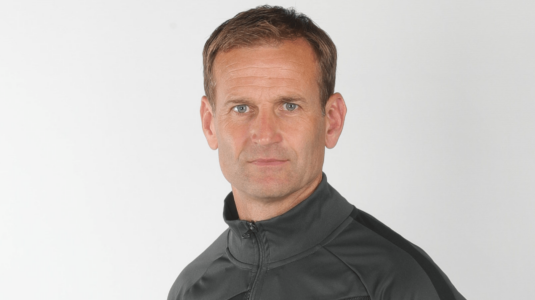
Dan Ashworth, who held the seat at three of the clubs in my count, found this when he helped write the FA’s Technical Director course and asked people what was in their job descriptions.
“It was so different,” he told the TGG Podcast in 2020. “Some are based on recruitment, some are involved in Academies, some have medical and sports science as well, some have training ground operations.”
The count at a glance
Of the 75 departures where the outcome was clear, clubs refilled the same job under the same title 25 times, redefined it 40 times and abolished it 10 times. Two departures in three changed the job.
The median time in the seat was about two years for the 79 spells that had ended. Eighteen clubs had three or more holders in the decade and nine had four or more different people (10 counting Fabio Paratici’s two spells at Tottenham separately), while Nottingham Forest had seven.
Three clubs, Preston, Cardiff and Sheffield United, had no dedicated Sporting Director or equivalent at any point in the decade. A fourth, Wrexham, appointed their first, Steve Nickson, in September, just after the count closed.
When a holder left, the club usually changed something: a new title, a visible restructure, the work split between two people, or nobody at all, with the duties folded back into roles that already existed. People come and go in every job, but in this one, the job itself keeps moving.
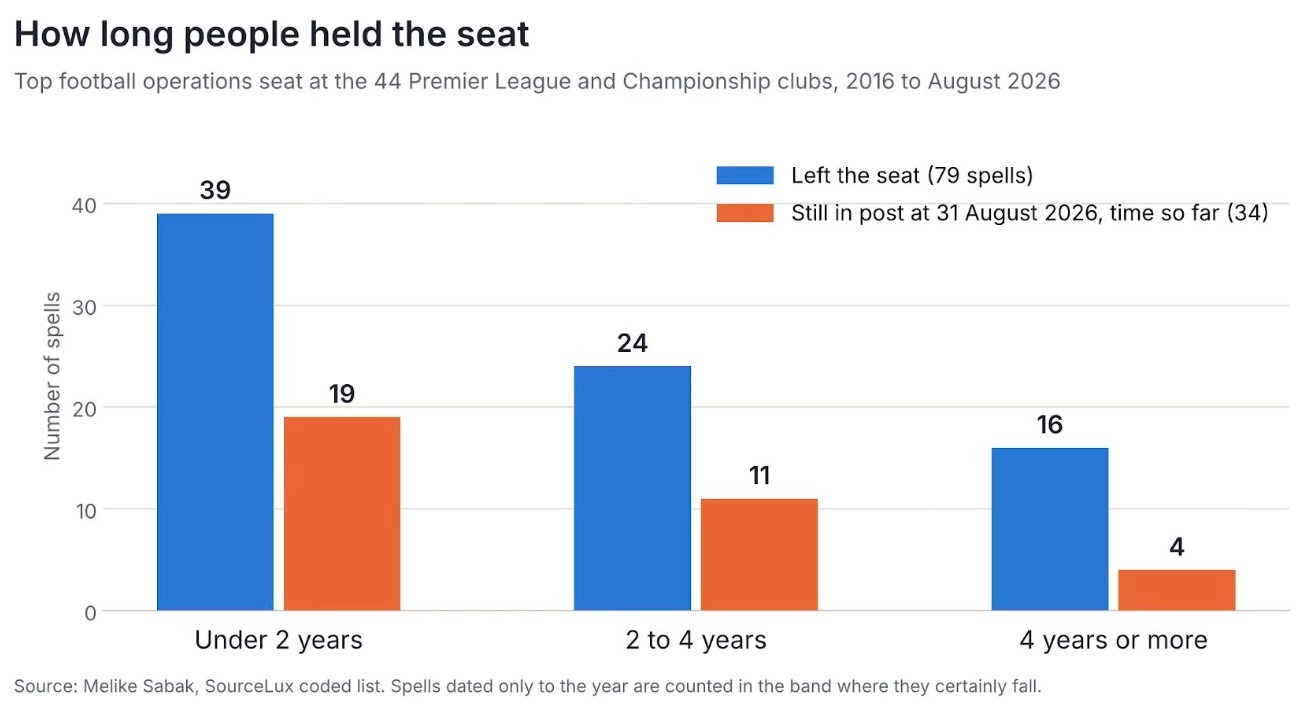
Most people who leave the seat do so within four years. Of the 79 completed spells, 39 ended inside two years, 24 between two and four, and 16 after four years or more. The median completed tenure is 24 months: about 26 in the Premier League and 23 in the Championship.
Counting the people still in post matters – and it cuts both ways. Phil Giles has held the seat at Brentford since 2015, and Tony Khan has run football operations at Fulham since 2017. Neither appears in the figure built only on completed tenures.
However, 19 of the 34 people in post at the end of August had been there for fewer than two years, so adding everyone straight into the median pulls it down to about 22 months. The fair way to count them is the method medical researchers use for survival data, a Kaplan-Meier estimator, which credits each person still in post with the time served so far.
On that basis, two in five holders were gone within two years, half within about 33 months, and seven in 10 within four years.
Changing job titles
Stability is rarer than it looks, even where a title endured. Liverpool kept the Sporting Director title through four holders. One of them, Jörg Schmadtke, came in on a short-term deal, and in 2024 Michael Edwards returned in a new role above the seat, as Fenway Sports Group’s CEO of Football, before leaving in July 2026.
Since the count closed, Richard Hughes has left as well, and Julian Ward has returned for a second spell. Everton kept Director of Football through three holders, then replaced the single seat with a wider sporting leadership team when Kevin Thelwell left in 2025.
Watford have called it Sporting Director every time, through six spells and five people. The cleanest continuity is at Manchester City, where Txiki Begiristain handed over to Hugo Viana in the summer of 2025 under the same title after more than 12 years, and at Brentford.
At the other end, the title gets redrawn almost every time that the seat changes hands. Nottingham Forest had seven holders and four changes of title: Pedro Pereira and Frank McParland as Director of Football, Luke Dowling as Sporting Director, Kyriakos Dourekas as Director of Football, Filippo Giraldi as Sporting Director, then Ross Wilson and George Syrianos as Chief Football Officer.
Swansea City had six holders and four changes of title, and Wolves changed the title at every handover: Sporting Director, Technical Director, Sporting Director again, Director of Professional Football, and now Technical Director again.
Seven clubs let the seat lapse for more than two years and later recreated it, and Derby recreated theirs only to let it go again. Burnley and QPR also abolished theirs and the trio have run without anyone in the top role for years. Others created one for the first time: Swansea in 2019, Portsmouth in 2021, Coventry this summer, and Wrexham, as mentioned earlier.
Why does the job keep changing? There are three ways to read it:
- The appointments were poor. This deserves more weight than people who write about structure usually give it. Some hires are bad. Some clubs hire on a relationship. Some of it could be bad luck. What this doesn’t explain is why, on the way to a new hire, the club so often changes the shape of the job. If the problem is the person, the fix is a better person in the same job.
- The role is young and hasn’t settled. This is the strongest of the ordinary explanations, and the move at several clubs towards splitting the remit across a leadership team is a reasonable answer to it. What it doesn’t cover is how often even the clubs with the most settled titles changed the job around them.
- The job itself is the problem. The seat carries demands nobody wrote into the job description, and they weigh on whoever holds it. Appointment data can only take you to the edge of this one. To go further, you have to talk to the people in the seats and read the institution around them.

The third is the reading I find most convincing. Put simply, the seat is built so that whoever holds it struggles. It takes the responsibility for decisions other people carry out, it is judged on a season for work that takes years, and it becomes the place a club parks the problems nobody else wants to own.
When the holder fails, the club changes the person or the title, and the next holder inherits the same load.
The idea comes from the Tavistock Institute, set up in London in 1947 to study how organisations really work. Its best-known study is Isabel Menzies Lyth’s, in a London teaching hospital in 1959: brought in to help allocate student nurses to the wards, she found the working routines were organised around managing staff anxiety as much as around patient care. Almost no football club has been read this way.
Start with the decisions. The seat announces them and sends other people out to finish them. It signs the player, and somebody else has selected him. It appoints the Head Coach, and somebody else coaches. Then it is judged on whether the whole thing worked.
Then the timescale. The holder is reviewed against a season and judged, later, against an institution. So it’s rational to put first whatever can be shown inside six months. The structure that would have outlasted the incumbent never gets built, and afterwards they are described as having lacked long-term vision.
Then the blame. When a club can’t share a difficulty out, it tends to park it in one place. The holder becomes the site of the complaint: everyone names them in the first 10 minutes, and the group defends that account, because the alternative is handing the difficulty back to everyone else.
That one can be checked. When the last holder left, did the same complaint attach itself to their successor within a season? If that has now happened twice, the problem isn’t the person.
Clubs splitting the remit across a leadership team should run the same check in 18 months, because spreading a job across four people doesn’t tell you what the job was carrying.
And nobody holds the holder. The seat sits between the board and the Head Coach and takes the collision when their timelines don’t match, but nobody in the building is there for the person in it. People who have held it describe it the same way: the role is lonely, and nothing prepares you for it.
Surgeons have supervision and airline crews have the structured debrief. Football has punditry, which was built for an audience.
If you’re offered the job
Based on my findings, my advice to anyone offered this job, or in their first year in it, is to ask about the seat before you ask about the squad.
How many people have held it in the last 10 years? And did the title or the job description change each time? If it did, the club has been redesigning the job rather than understanding it.
What happened to the last holder? And what were they blamed for? Listen for whether the same complaint was made about the one before them.
What will you be judged on, and by when? If everything that counts has to be shown by May, nobody will thank you for building something that lasts.
Who will you be able to talk to? Not the owner and not the Head Coach, but someone with no view on your future and no stake in the outcome. If no name comes to mind, that gap comes with the job, not with you.
If you’ve already taken the job, use the first year. It is the only time you can still see the gap between the job you were given on paper and the one you are actually doing. After that it starts to feel normal, and once it feels normal you stop noticing it.
Whether the last three holders were any good is the wrong question. The useful one is what you’ve walked into.
Methodology: How I counted
For every holder who met the role criteria, I recorded start and end dates, the title exactly as the club wrote it, predecessor, successor, and how they left. Then I coded each departure by what happened to the seat afterwards.
- Refilled: a successor under the identical title
- Redefined: a successor under a different title, or the responsibilities visibly restructured
- Abolished: nobody appointed, and the work absorbed elsewhere
Interim appointments and internal title upgrades don’t count as departures. Where a club ran two senior football roles at once, I counted the senior one, and when a club put someone above the holder, the holder’s spell ends there and counts as redefined.
A seat left empty for more than two years and then recreated counts as abolished; after a shorter gap, the departure is coded by the successor’s title. Where I couldn’t confirm a successor, the departure stays out of the split, and that includes two seats that were vacant and being recruited when I closed the count.
Tenure runs from the confirmed start, including any time before 2016, and for people still in post it runs to 31 August 2026. Where a date is known only to the year, the spell counts only if the missing month can’t change its band, and it enters the medians on the side where it certainly falls. Five completed spells are counted that way, three of them in the Premier League figure. I didn’t guess.
My sources, in order of trust: the club’s own announcement, Training Ground Guru, Transfermarkt’s staff histories, then the major outlets. Recode the borderline cases either way and the share of departures that changed the job stays between 64 and 71 per cent.
The full count
Every holder of the top football operations seat at this season’s 44 Premier League and Championship clubs, 2016 to 31 August 2026. Months in post runs to 31 August 2026 for anyone still in post; where a date is known only to the year, it gives the range in which the spell must fall.

Melike Sabak is a psychoanalytically trained practitioner who spent 13 years running operations inside high-stakes owner-led organisations. She is the Director of SourceLux, based in London, which reads how football clubs are structured and how they actually run: why the same problem returns whoever holds a role and what a seat carries that nobody assigned to it.
Follow Us
For latest updates, follow us on X at @ground_guru