Missing part of performance: What clubs get wrong about players’ partners
Written by
Dr Sofie Kent
October 14, 2026
As a Sport Psychologist, I have worked with a range of key stakeholders during the course of my career: athletes, coaches, sport scientists and parents.
However, romantic partners have rarely been actively supported or meaningfully integrated into the wider performance environment – either during my training or in my subsequent work in elite sport.
Most clubs now employ a Player Care Officer, who will help families with the logistics – relocation, finding schools, and in some cases building a social network from scratch. That work matters, and the partners we interviewed valued it.
But practical help solves practical problems. It does not equip a partner to cope with the moods and behaviours that follow a player home from the training ground.
It is rarely recognised – by clubs, or by partners themselves – that living alongside a professional athlete demands psychological skills of its own: to navigate the pressures of elite sport, protect your own wellbeing, support the player’s performance and sustain the relationship.
Athletes often turn to those closest to them long before they seek support from a professional.
Dr Sofie Kent
Maintaining partner wellbeing and reducing work-family conflict are strategic priorities in other high-pressure occupations, including the armed forces and emergency services.
Such organisations recognise that these jobs are stressful and that the emotional demands experienced at work transfer into home and relationship life.
As a result, psychological initiatives are often implemented with family members to help partners better cope with the pressures associated with the job. A more supportive home environment may in turn help protect employee wellbeing and sustain performance.
To my surprise, elite sport has not taken the same psychologically informed approach to its work with partners.
This limited attention may reflect the historically athlete-centred focus of sport psychology research. It may also reflect the stigma and stereotyping that surrounds partners – who are still, at times, viewed as a potential distraction to the athlete rather than as part of the support system around them.
Yet the evidence points the other way. Athletes often turn to those closest to them long before they seek support from a professional.
In a survey of 523 elite athletes, only 7% named their sport psychologist as the person with whom they mainly discuss their troubles, and fewer than 2% named their coach. Friends, family and partners were relied upon far more readily.
Strengthening relationships and integrating family within the sport system at senior level is also a key recommendation within elite sport mental health frameworks.
What the research found
Romantic partners of professional football players may experience unique demands that place considerable strain on intimate relationships.
However, in a recent literature review there was little football-specific information available for practitioners to understand the range of stressors these partners might experience.
As a result, any support offered by sport science, player care and sport psychology staff is based heavily on intuition, personal experience or an existing familiarity with the football industry.
That presents a particular challenge for practitioners who have not lived or worked within professional football, and who may find it harder to appreciate the realities of life alongside a player.
To support these individuals properly, it was important for me to understand the stressors that partners experience and the potential implications for their wellbeing, their relationships and, in the case of players, performance.
We interviewed seven women – all of whom were wives or girlfriends of players in the Premier League, the English Football League, Major League Soccer and Australia’s A-League.
They face unique and ongoing psychological demands throughout the season, around performance and injury, transfers and relocation, sacrifice and identity, stigma and abuse, and difficulties with help-seeking.
What struck us was not simply the volume of stressors, but how partners managed them. They were constantly screening what was allowed into the relationship and what was allowed out of it, in order to protect three things:
- the career and the lifestyle it provides
- the relationship itself
- their own identity and wellbeing
We called this border control. The most useful part of it, for practitioners, is what it does to help-seeking.
Psychological models of stress generally assume that a person under pressure asks themselves: what resources do I have to cope with this? Partners asked a second question first. Is it safe to cope in this way? Almost every decision about whether to speak up, and to whom, ran through that filter.
Partners spoke positively about player care staff, particularly for practical support such as relocation and help establishing social networks. But the demands they described went well beyond the logistical.
One partner said: “When it’s going bad, it’s horrendous and it impacts everybody’s lives. When things aren’t going well, [player] is definitely looking for ways to improve, so there is a roll-on to everyone’s life.
“You see them less, so that they’ve got more time to stay training late. You definitely take a back seat.”
Some experienced significant stress directly because of their association with a player, including stigma and online abuse. Both intensified in the UK and at the higher levels of the game.
One said: “I have had people opening accounts in my name, an [adult site] made in my name. It made me feel so uncomfortable that I did not want to go to the games with people thinking they have seen videos of me doing God knows what. It was not nice for [player] either. I was really upset about it.”
Experiences like these can have lasting consequences for how partners interact with other people.
One described how she became increasingly guarded following breaches of trust: “You can become quite isolated and insular. Once you have been burnt you become more conscious of who you reach out to, because you do develop really bad trust issues.”
Why partners look outside the club
That second question, is it safe to cope in this way, has a measurable consequence. Five of our seven partners said they would seek support outside the club rather than within it. For several, the first call would not be to a member of club staff.
One explained: “I don’t think at first point it would be the clubs I’d go to, it’s his agent. We’ve built a good relationship and built rapport and have felt safe to disclose [psychological challenges] to him, and then after that it would be any specialists.”
The reasoning was consistent. Most believed a club would respond quickly if they raised a concern about injury or mental health. What they were uncertain about was what would happen next. Across all seven there was a shared worry about repercussions, deselection above all, which shaped both whether and when they came forward.
Two described approaching an in-house club psychologist as a potential threat to the player’s career, and anticipated that the player would not want the disclosure made. That is worth sitting with – the service designed to help was itself being read as a risk.
Inconsistency compounded the problem. Partners noticed, acutely, who got checked on and who did not.
One said: “One of the players suffered with anxiety, he had three weeks off, which is unheard of. [The CEO] is big into mental health, so phoned him. But I’m also like, why didn’t they call [husband] when he was injured? I know from other partners [the CEO] checked up on two or three of the players, but not everyone.”
Some went further, and questioned whether their exclusion was accidental at all. Three believed clubs may avoid engaging with partners because acknowledging a dysfunctional or abusive relationship would create a duty of care and carry reputational risk.
One felt that some clubs simply view partners as “extra workload, and doesn’t lead to the angle of making them money”. Another pointed to who is in the room when these decisions are made:
“Decision-making positions are held by men of the same demographic. Not enough women, mothers within roles, and not enough men speaking up and saying, ‘you know what? If [partners] were happier at home, then [player] would feel more settled’. Perhaps they don’t want to acknowledge an issue as something has to be done about it.”
It would be wrong to suggest that no club does this well. The same interviews produced clear descriptions of environments that worked, and they were rarely elaborate.
Partners are often left to develop these skills alone, sometimes while entering the professional football environment at just 19 or 20 years old.
Dr Sofie Kent
One partner, who had moved five times, said one particular club stood out: “[The coach and his wife] would speak to me. It’s great to talk about soccer, but it’s nice to not talk about soccer too. It felt like home, you were a unit, you were valued, they understood how important it was for the boys to know we were OK.”
Small, deliberate gestures mattered: flowers on a birthday, a team bonding day, partners included rather than tolerated.
So did credibility. One described a sport psychology service that was endorsed by the club, by the players’ association and by other partners, and which players were known to use openly. That combination made it feel safe to use herself: “I’ve spoken to his sports psych before and had Zoom calls with him. Whenever he’s had issues I’ve gone in with him too.”
The pattern is that trust gets built before it is needed and through visible endorsement rather than a leaflet.
What clubs can do
These are psychological challenges that require specific psychological skills. This is where sport psychology can complement player care.
Many partners do develop ways of coping through experience. But a partner’s ability to provide effective support is influenced by how effective those coping strategies actually are, and no single strategy works in every situation.
Suppressing emotions, for example, may protect the player in the short term. Relied upon repeatedly, it can leave the partner managing their own stress without support.
Partners are often left to develop these skills alone, sometimes while entering the professional football environment at just 19 or 20 years old. A sport psychologist could accelerate that learning through targeted psycho-education.
Our findings pointed to three areas in particular.
1. Self-compassion
Self-compassion helps an individual respond to difficulty with kindness rather than harsh self-judgement.
Partners in our study often felt guilty about seeking support or admitting they were struggling, because of an assumption that they should be grateful and have little to complain about. Being financially fortunate did not remove the emotional impact of an absent partner, or of abuse on social media or in-person.
One said: “We’d lost a baby before, so when [child] was poorly, I didn’t cope at all. I had really bad postnatal depression, and I was on my own with a six-year-old and a newborn baby after a C-section, as [player] doesn’t get paternity leave… We are really fortunate, but that does not mean we can’t miss him.”
That was not an isolated case. Paternity leave exists for players, but every partner in our study reported that it was given up almost immediately after the birth.
Self-compassion may help partners acknowledge that privilege and psychological difficulty can coexist – reducing self-judgment and potentially making it easier to seek support when it is needed.
2. Coping flexibility
This is an individual’s ability to draw on a diverse range of coping strategies and, more importantly, to adapt them to unpredictable changes and stressors.
One partner disclosed experiencing abuse and wanting to lash out. Rather than argue, she now writes blogs to “tackle problems head on”, which has helped her cope.
Another described suppressing her own anxiety during the uncertainty of the January transfer window because she did not want to add to the player’s stress: “We’ve now moved five times… I never sleep running up to the [January transfer] window; I hate it… everything goes through your head, and I think the uncertainty is hard… I just need to not let him know [I’m stressed] because obviously, it’ll add to his stresses.”
Psychoeducation could help partners build a broader coping toolkit and the confidence to recognise when, where and how different strategies are most effective.
3. Mental health literacy
Mental health literacy would help partners recognise the signs of psychological difficulty, understand when additional support is needed, and know what professional services are available – for themselves and for the player.
This matters because partners are often the player’s first source of support, yet many were uncertain about where it was safe to disclose concerns, and what might happen if they approached the club.
One said: “It’s difficult to know who and what you can disclose stuff to… He’d be awful. The house would be awful, and no-one from the club would reach out and be like, ‘how are you dealing with things?’. He was drinking a bottle of red wine nearly every day.”
That uncertainty is worth clubs addressing directly, because the answer is not the same for every member of staff. Registered Practitioner Psychologists are regulated by the Health and Care Professions Council and are legally bound by confidentiality, except where disclosure is required by law or where there is a serious risk of harm.
Player care staff are not bound in the same way, and information may be shared in line with club policy and safeguarding responsibilities. Both roles are valuable – but partners should be told clearly which is which.
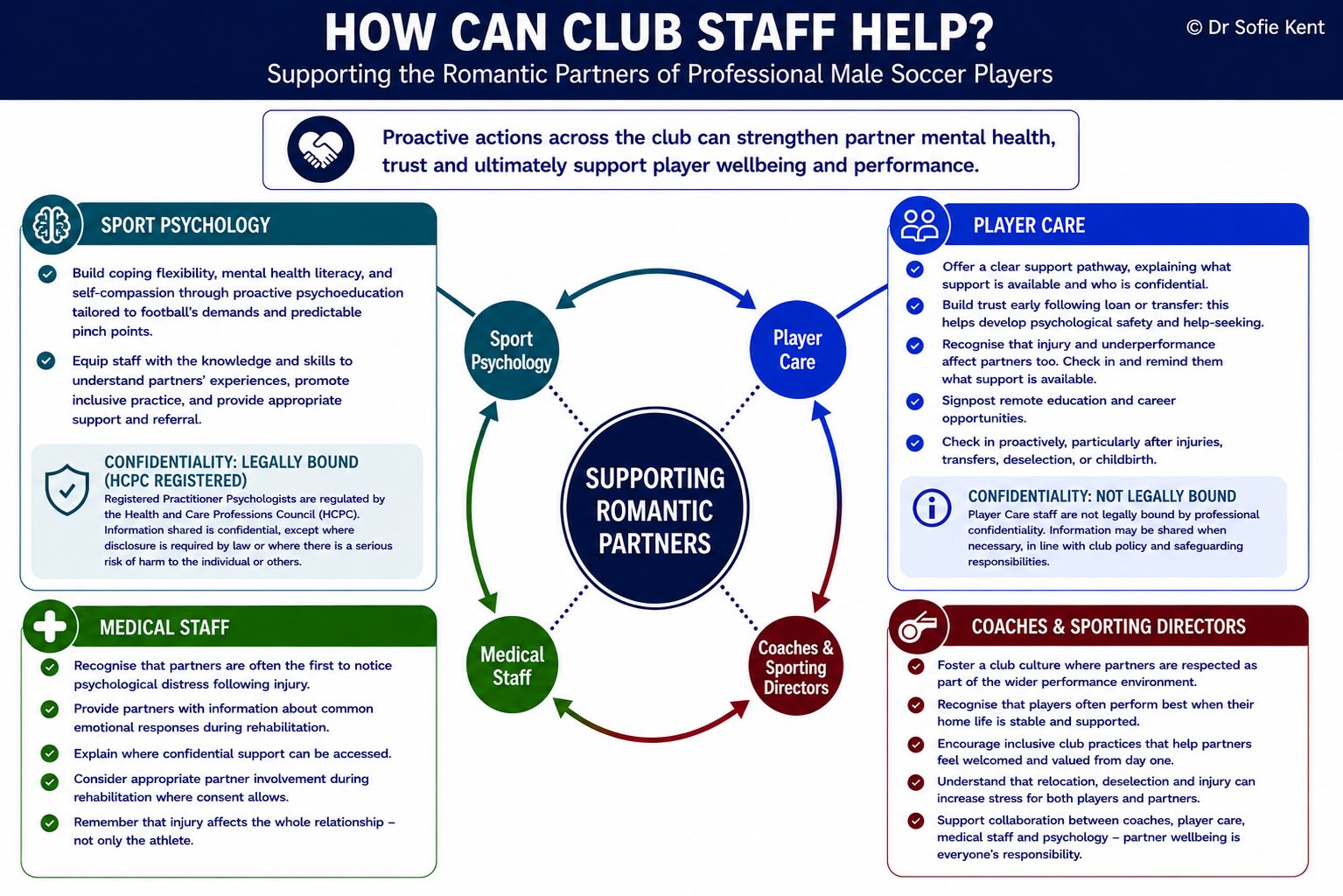
What each department can do to support partners. Graphic: Dr Sofie Kent
Putting it into practice
From a psychological perspective, none of this requires an extensive programme.
These ideas could be built into workshops delivered at relevant points across the season: transfer windows, periods of injury, relegation battles and play-off campaigns, when social media abuse tends to intensify. Trust is also easier to build early – following a loan move or transfer, rather than at the point of crisis.
One caution on partner support groups, which more clubs are now setting up. They can be the single most valuable resource a partner has. As one put it: “The girls in soccer become your family, they have all been through it and can help you.”
But groups that dwell on future worries such as retirement or divorce, without offering any strategies for coping with them, can raise anxiety rather than lower it. One partner came away from a session unsettled: “A year ago things were fine, so how has it got to this?”
The answer is not to stop running them. It is to have somebody trained in the room.
Crucially, the aim is not to teach partners to become psychologists for players. It is to equip them with the knowledge and skills to protect their own mental health, to respond more kindly to themselves during difficult periods, and to adapt how they cope as circumstances change.
In doing so, partners may be better placed to remain an effective source of support, to recognise when additional help is needed, and to reduce the potential for difficulties at home to spill over into the player’s mental health and performance.
Elite sport has innovated in almost every other area of performance. On this one, other high-pressure industries are ahead of us. I hope this piece encourages clubs to close that gap.

- Dr Sofie Kent is a Senior Lecturer in Sport and Exercise Psychology at Leeds Beckett University and a HCPC-registered Sport and Exercise Psychologist. Her study of the partners of professional footballers, Border control, was published in July. An earlier study of partners across a range of sports is free to read in full.
Follow Us
For latest updates, follow us on X at @ground_guru