Lee Johnson: Turning communication into measurable data
Written by
Simon Austin
March 13, 2026
Lommel Head Coach Lee Johnson is taking a pioneering approach to developing the communication skills of players and coaches, using a combination of data and technology.
The former Bristol City, Sunderland and Hibernian manager has been in charge of Belgian Second Division side Lommel since March 2025. He was speaking at TGG Live 2025 on a panel about how player, coach and data scientist can work together cohesively.
Former England and Manchester United defender Phil Jones and Teamworks Data Scientist John-Mark Sisman were the other members of the panel chaired by Sarah Mulkerrins.
Johnson explained how he had been using a product called Vokalo to analyse and develop the communication of both players and coaches. During training, Lommel’s players wear small wireless audio devices featuring premium microphones inside vests under their shirts.
The coaches can then monitor the high-quality voice capture, either live or for review. The players are able to double-tap the device to tag key communication moments concerning either player or coach communication.
This means, uniquely, that Vokalo uses communication to generate not only audio files, but data too.
Johnson said: “I’m forever listening to coaches or managers say, ‘They don’t talk anymore’. And I’m thinking, ‘Yeah, but do you coach it?’
“We coach it as a sub principle to a session, but are we coaching it as the principal point? And if so, what technology have we got or what data are we using to give feedback to the players to bring them along as much as possible?
“We’ve been Vokalo, which is new. Basically every player wears a pod and it records the session. Also they can provide feedback.
“So within the session, if I’m ranting and raving or I’m in the middle of the show in terms of the coaching, they can tap the product a couple of times and leave me a feedback, which I can go back and review. Then the day after we can learn, review and re-do consistently.”
First and foremost, Johnson said it’s vital to get player buy-in for this process of communication monitoring and review.
“It can’t be surveillance,” he insisted. “They have to know that you’ve got their best interests at heart, first and foremost. And then you have to use that data and the listening power in the correct way. And I think we’ve got that, at Lommel, which is important.”
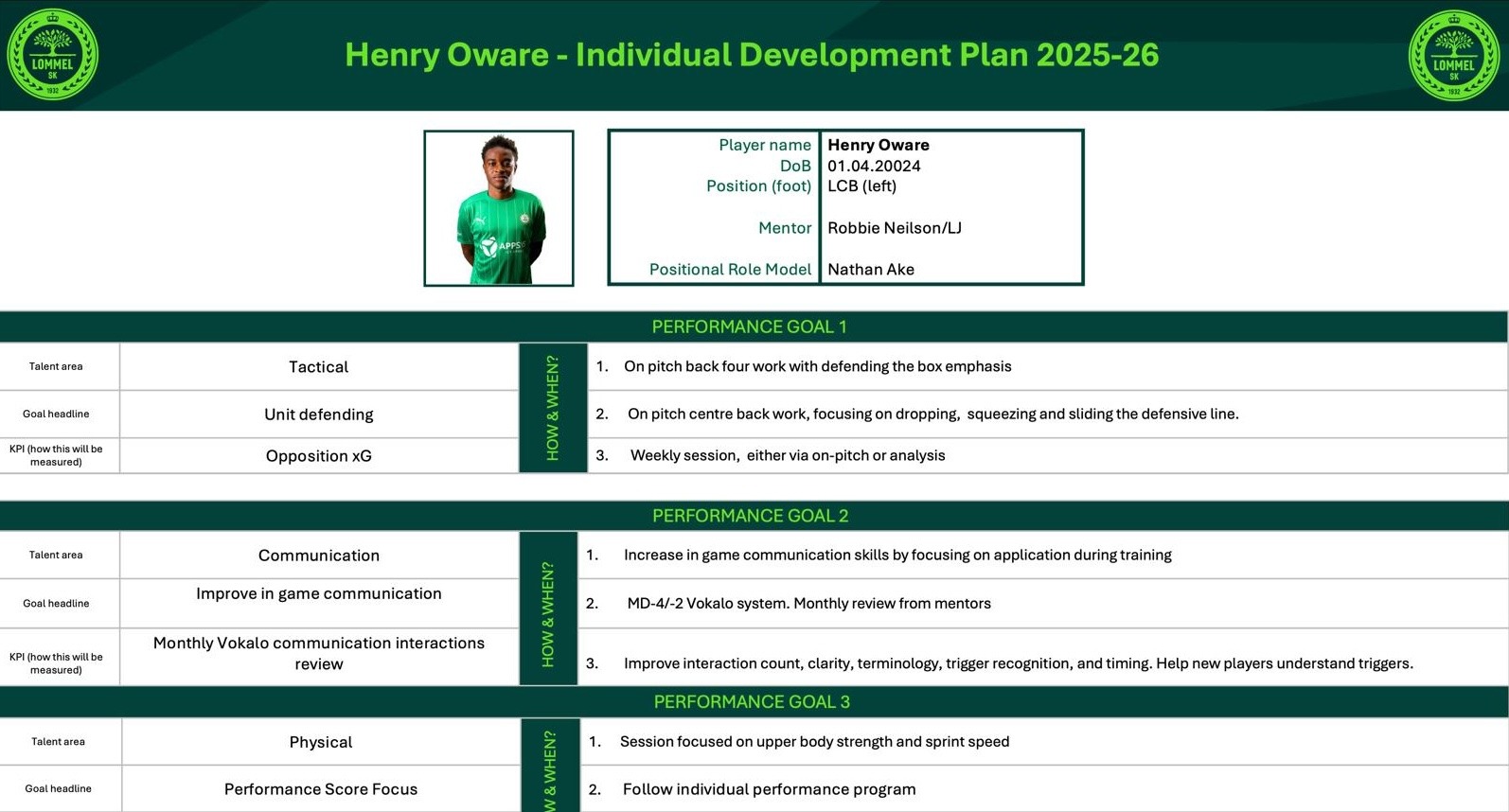
Communication is included as a goal in some of the players’ Individual Development Plans, like centre-back Henry Oware.
“He was recruited by our good friends at the back of the room in Emerging Talent at CFG, from a Ghanaian Academy,” Johnson explained at TGG Live 2025, which was held at Manchester United’s Old Trafford. “We picked him up via our sister club Troyes, one of the group clubs.
“First of all, he is just an unbelievable lad and a great character. I think that’s the most important thing. But he needs a little bit of polishing in terms of the tactical and technical. And importantly, the bit we’re talking about today is communication.
Johnson said he and his staff were constantly looking at the context and psychology around communication.
“When we’re feeding back, we’ve got the video analysis, but you’ll also see this data,” he said. “What we found is the psychology element of communication has been really, really interesting.”
He used Oware’s communication data from four pre-season games as an example.
“Like you’ll see in the Venlo game – 4.2 interactions per minute. Yeah, not bad. But Henry made a big mistake in that game and, psychologically, the lads dug him out a little bit. He was disappointed and he actually stopped talking for a good three minutes.
“And we talked about it, we reviewed it, we showed in the charts, we reviewed all his interactions and then the Man City game, which was his most vocal game, you can see a consistency there. So is the game state affecting communication?
“Is the fatigue levels affecting a player? You can see in the Rakow game, in the top one, it’s the first game of pre-season, there’s a big dropout in communication because of fatigue levels. So we’re always looking for these, to try and illuminate the story, to highlight.”
And he used two in-game clips to illustrate Oware’s developing communication.
“There’s an 18-year-old Nigerian player called Dominion Ohaka that’s new to the group and he (Oware) is teaching him the triggers.
“The volume is important, the trigger recognition is important. And then obviously giving that concise clear information. This is a player that didn’t talk a lot at the start, averaged at about one, two communication interactions per minute.
“I’m not saying that’s John Terry, Phil Jones-type levels, but this is a player that’s improving. And what you’ll see, from our defending as a group, Henry’s been a big part of that, because from the last six games of the season to the first six games of this season, our defensive record has improved hugely.
“Again, a percentile of that has been from our laser focus on the communication element, it’s amazing. And Henry’s been a massive part of it.”
Jones, the former Manchester United and England defender who was on the panel alongside Johnson, said: “I remember playing with Rio (Ferdinand) and he used to say to me before a game, ‘Jonah, just tell me anything, tell me anything. Doesn’t matter what you speak about, just communicate with me during the game.’
“And it’s just that constant dialogue during the game. When you’re winning, everyone wants to talk. When you’re losing, everyone wants to go into their shell a little bit and nobody really wants to take responsibility.
“But it’s so true with the communication element and the way you’ve used the data to enhance that within your team, the squad, it’s brilliant, brilliant.”
Johnson said tailoring communication according to each individual player was vital for a coach.
“As a coach, I think that can bring the best out of people,” he said. “Sometimes it’s banter, sometimes it’s serious, sometimes it’s data-led, sometimes it’s the horse whisperer, where you put your arm around them and go to training and tell them that the session’s about them.
“So it’s that holistic view, not just from me, but from the coaches and then ideally the players and in particular the senior players as well.”
He also said the club used a ‘gang coaching’ method when it came to the IDPs.
“Our players’ IDPs, their technical and tactical, are open to everybody else and the senior players have got an element of responsibility to help the younger players develop as well.
“We’ve gone down the route of a gang coaching method, which I absolutely love. There are certain review dates when we review the communication. Probably match day plus two would be a day where we’d always set aside time for individual IDPs, sometimes match day minus one, but only 10 minutes, and then certainly match day minus two as well.
“It’s something that I think CFG in particular do really well. I hadn’t always valued the documentation and the implementation of the data to match up with that as much as I have since I’ve been here.
“And obviously I’ve seen the improvement from the lads and also the buy-in. Because unless they’re buying in, there’s no point.”
This content is for TGG Members
Join up today and get access to:
- All articles: news, interviews, analysis
- Masterclasses & Online Conferences
- Full Academy Productivity Rankings
- Club Directory: 1,000+ staff profiles
- Personal Profile Builder
- TGG Live 2024 & 2025 presentations