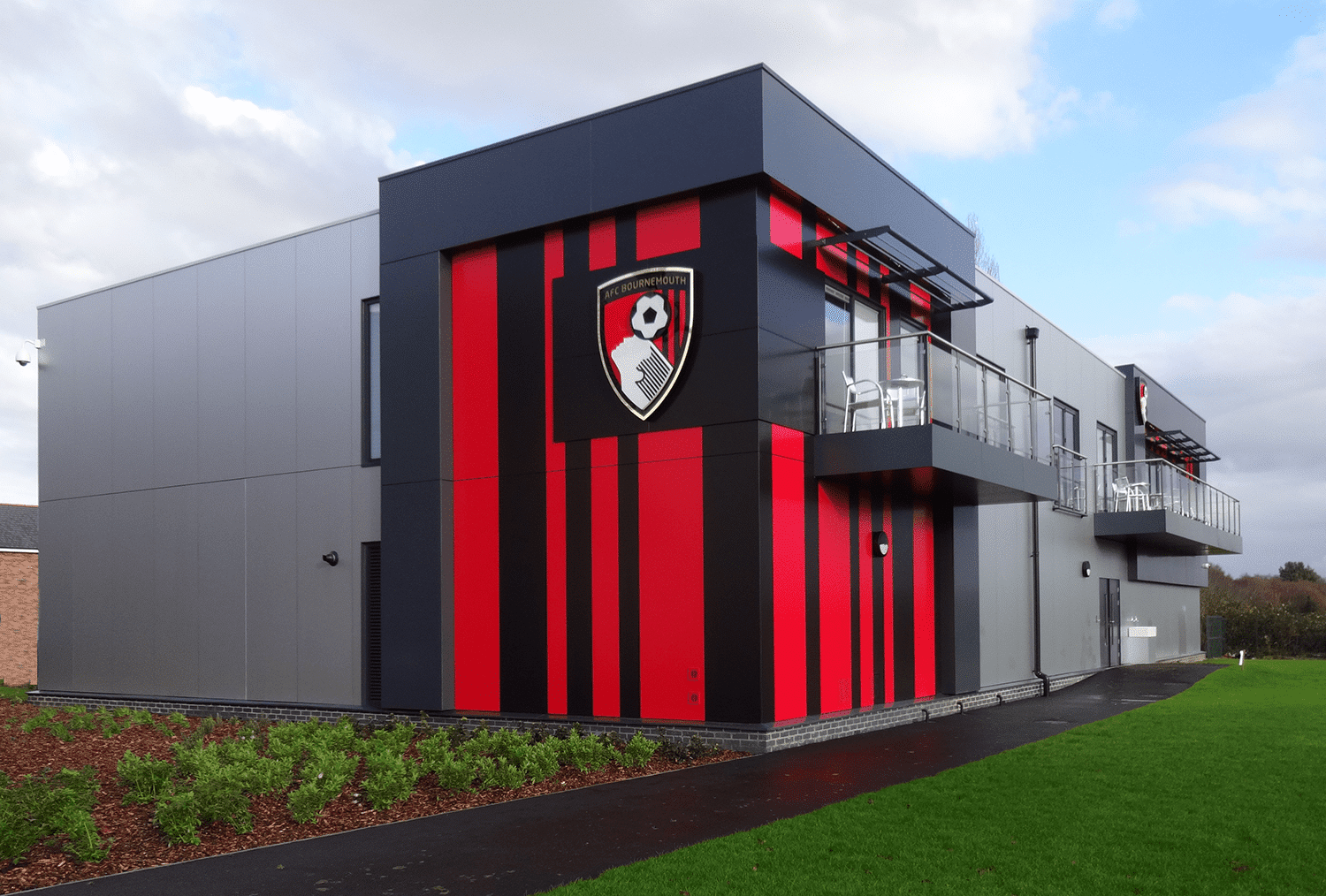
How clubs build elite training centres in weeks, not months
Written by
Simon Austin
January 7, 2026
When AFC Bournemouth were promoted to the Premier League in 2015, capping a remarkable seven-season rise from League Two, they needed a training facility fit for the top tier – and fast.
Previously, the players had been changing at their Dean Court stadium and training on an adjacent pitch at Kings Park. With 11 weeks to the start of the new season, they now needed Premier League standard facilities with dedicated areas for sports science, medical care, analysis and staff support.

Planning permission for a two-storey Training Pavilion and boiler house for under-pitch heating was granted at an extraordinary meeting of Bournemouth Borough Council’s planning committee on July 1st.
Now the club needed a company who could build the Training Pavilion in a dramatically short space of time. Step forward Modulek, a family-owned construction firm based in nearby Verwood.
Modulek specialise in the construction of modular buildings that are manufactured in a factory, transported to site and then craned into place. They had never worked in football before, but took on Bournemouth’s daunting challenge with relish.
“Seventy-five per cent of the build is done in the factory, which gives quality assurance, speed and efficiency,” explained Dan Pester, one of five brothers running Modulek.
“These buildings are delivered and completed in 50% less time than traditional build. The quality is the same, with a guaranteed 60 years’ design life, but can be up to 10% cheaper than traditional build.
“Modulek looked after the complete project for AFC Bournemouth, including site preparation, groundworks, services connections, building manufacture, delivery, mechanical and electrical installation, decoration, floor finishes and even furniture!
“The way these buildings are finished on-site, you would never know they are an off-site manufactured building. There really is no difference from a brick-built traditional build.”
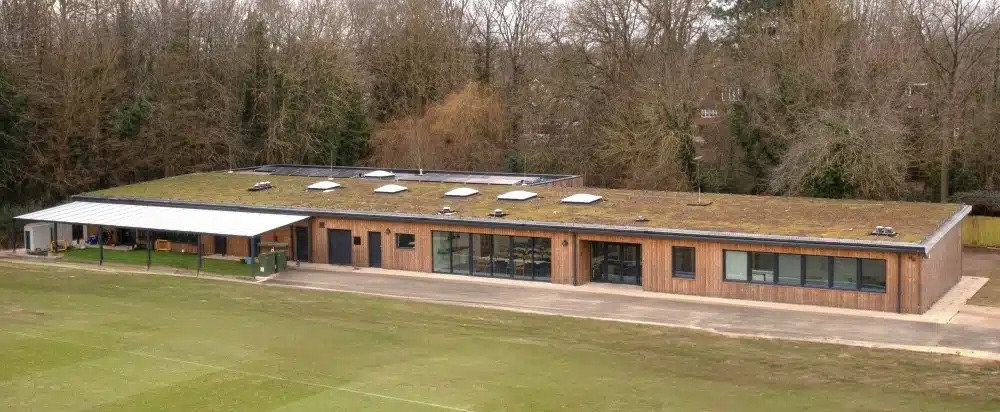
Cambridge United's new eco-friendly Training Pavilion
Bournemouth’s two-storey Pavilion had treatment and medical rooms, a gym, players lounge, media room and hydrotherapy pool with hot and cold plunge areas.
What impressed me most was the speed of how they worked, the quality of their craft, the manner in which they did it.
Eddie Howe
“The project was 12 weeks in the factory and then less than eight weeks on site to complete,” said Pester. “We were very proud of the final product.”
Manager Eddie Howe was too.
“We knew it was going to be a big moment, getting in our training base in one venue, improving our facilities in line with the Premier League,” he said.
“What impressed me most was the speed of how they worked, the quality of their craft, the manner in which they did it.”
Since then, Bournemouth have moved to a new £32m training complex at Canford Magna – and Modulek have gone on to work with a number of other football clubs, including Wolves, Cambridge United, Exeter City, Sheffield Wednesday and West Ham.
The requirements of football clubs tend to be fairly unique, as Pester admitted.
“All the clubs we have worked with we have had to go in at the end of the season and work flat out in the close season. Football clubs like us because of the speed and value they get without having to sacrifice on quality.”
Cambridge opened their new Training Pavilion in December 2023. Chief Executive Alex Tunbridge told TGG it was “the best training ground in League Two and it would be one of the best in League One too.”
The entire project cost £3.5m, including ‘enabling works’ (site clearance, surveys, ground preparation, access routes etc) and there were strict planning restrictions concerning the design of the Pavilion.
The single-storey building had to be sympathetic to the environment and sustainable, adding another layer of complexity. It also needed to accommodate both the first team and Academy at Cambridge.
The finished facility had a central dining area for all teams, with offices, meeting rooms and an analysis room off to one side, with treatment rooms and a state-of-the-art gym overlooking the training pitches off to another.
The building was timber clad, with a sedum (living) roof, solar panels, ASHP (Air Source Heat Pump) hot water and rainwater harvesting. It was BREEAM (Building Research Establishment Environmental Assessment Method) certified and only four points off net zero.
Tunbridge said: “You would never know that the Training Pavilion is modular. The modules are all locked together and we have three changing rooms, two physio rooms, an analysis theatre, offices and a gym.
“In total there are 17 modular buildings and it’s portable if in future we wanted to move them to a different site.”
Officials from other clubs have been to visit Cambridge’s new facility and have been suitably impressed, meaning Modulek’s quick-turnaround close-season builds are set to continue.
Follow Us
For latest updates, follow us on X at @ground_guru