Written by
Simon Austin
March 4, 2026
Fulham Women are the Invincibles, unbeaten in the league for the last two seasons and bidding for a second successive promotion.
The team haven’t tasted defeat for almost two years, since they were beaten 2-1 at Dulwich Hamlet on April 4th 2024.
Now Steve Jaye’s side sit top of The FA Women’s National League Division One South East and are well set for promotion to the third tier.
The history of Fulham Women is full of highs and lows. In 2000, they became the first professional women’s team in Europe and went on to win a domestic treble of women’s Premier League, FA Cup and Premier League Cup in 2002/03.
Three years later, the team didn’t exist at all, with high costs, poor media coverage and low attendances cited as reasons for their closure.
Fulham Women were reborn in 2014 and a journey through the divisions began, with a place in the Women’s Super League regarded as the ultimate destination.
Technology is at the heart of this renaissance, with Hudl’s Pro Suite of tools utilised across the performance, analysis and coaching departments.
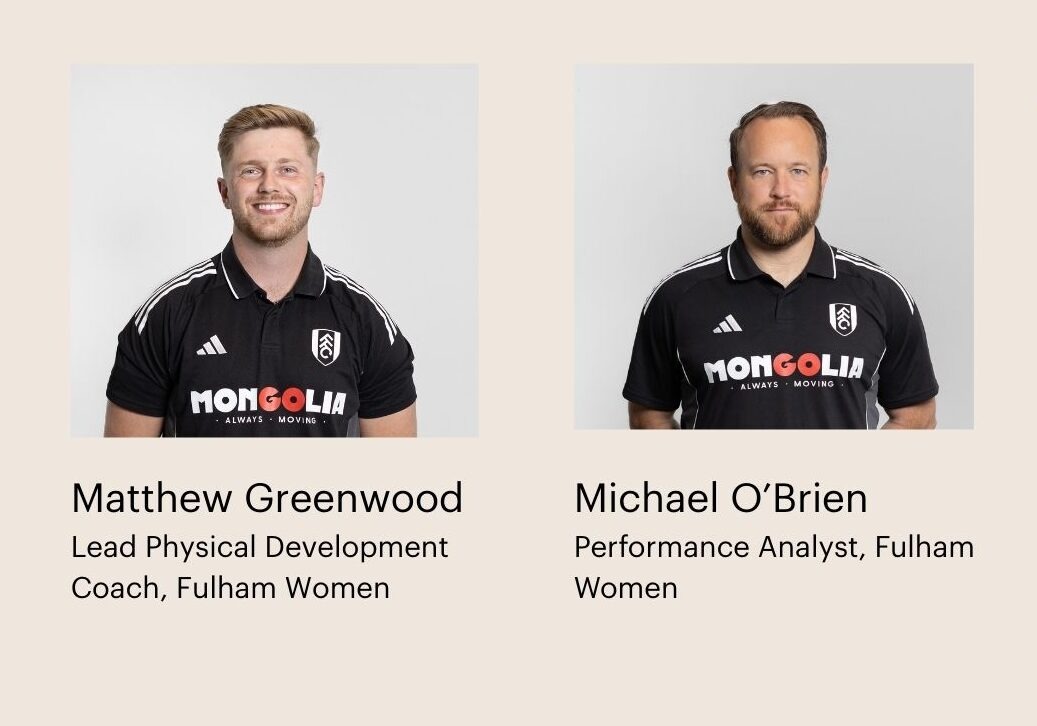
Performance Analyst Michael O’Brien and Physical Performance Coach Matthew Greenwood deploy many of these tools and workflows and will be delivering a special Webinar on how Fulham Women use tech to power success on Monday March 16th.
It’s FREE to register and you can join HERE. Ahead of the session, the duo sat down with TGG to give an insight into their work:
Training
Fulham Women are part-time and train on Tuesdays, Wednesdays and Thursdays at the Motspur Park base they share with the men’s team and Academy in south-west London.
Greenwood started at the club as an intern and has experienced major changes in the way they prepare over the course of the last three seasons.
“In my first year, we were only training twice a week,” he tells TGG. “Now it’s three times a week and we have our own allocated gym, plus more staff, which makes a big difference, because we are able to deliver a lot more in the programme.”
Fulham Women, who count striker Ellie Olds (pictured above) among their stars, use Hudl’s WIMU GPS units to track and analyse performance in real time. The players wear the units, which are housed in sports vests under their shirts, in the gym, on the training pitches and during matches.
“The unit has four accelerometers, a 3D magnetometer, three gyroscopes and a barometer – it’s state-of-the art, but also lightweight compared to others on the market,” Greenwood says.
“All the data that’s collected feeds into a platform called Hudl Signal, which is where the data processing takes place and that’s where we get our outputs, reports and visualisations.
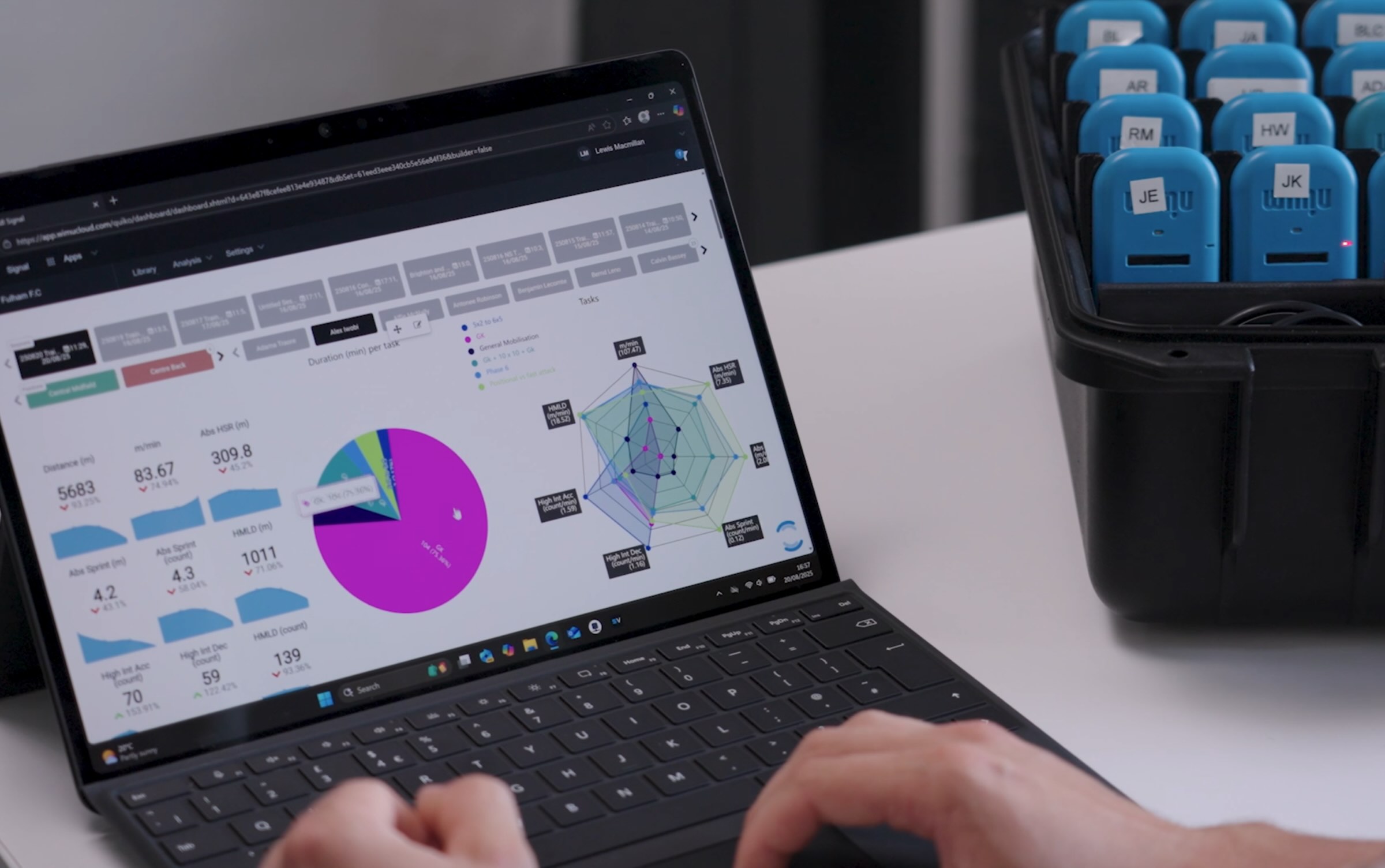
The team use Hudl Signal to create bespoke and dynamic dashboards that fit their specific performance needs. Daily reporting, microcycle analysis and longitudinal analysis are some of the options available.
“We get metrics like sprint distance, high-intensity sprints, top speeds and accelerations. If anything really stands out, like a player having a much bigger top speed than normal, I can check the data against the video to see why.
“We have markers I expect the players to hit and we look at work-rate metrics. As the gaffer says, if you have a base of being fitter than the opposition and working harder than the opposition, that sets the tone from the start.”
Training is sometimes filmed, using either the fixed Hudl Focus Outdoor camera, or the portable Focus Flex, both of which are fully automated and upload footage directly to Hudl.
“In terms of the Flex and the Focus, we use them for training if there are specific things we think will really help the players understand or visualise what we’re trying to do,” explains O’Brien, who has also worked for the club since 2023.
“Last week we had training on the Arena pitch (the mini stadium that the team use for their home games). We filmed that with the Focus cameras.
“That was uploaded via ethernet and some of the footage was added into our pre-match presentations for the players, just to give them some pictures around the different patterns and ideas we want to see and different solutions to try and break down the opposition.”
Matchday
Home matches are filmed on the Focus Outdoor cameras; away games with the Flex.
“We collect video clips about specific tactical moments to show to the players at half-time,” O’Brien explains.
“Any data we want we have to capture ourselves and create the workflows to record it, store it, analyse it and find insights.”
Fulham Women’s game model is to “try and control the game, keep possession of the ball and be deadly when we turn it on and attack,” says Greenwood.
O’Brien adds: “We can break down the game into its parts and say how we progress the ball, how we build. We can look at the different moments in the game and we do a lot of work with the players around that.
“Everything we do throughout the season is building on that. We’ve got a strong foundation that we build from and a lot of the information we’re giving to the players is just reinforcing that core information.
“The players then do really well at finding solutions themselves. Certainly when we find ourselves in situations in games where we have to adjust, we have to find all find ways to solve problems on the pitch.
“I think we’ve developed a group of players that are strong in those aspects and actually probably have quite strong analytical skills.”
Post-match
All of the information that’s collected during matches enables a sophisticated post-match process.
“One of the things we’ve brought in this year is a detailed technical debrief on a Monday after a game on a Sunday,” says O’Brien.
“All the clips we’ve created in-game, via Hudl Sportscode, we put them into an organiser and add notes, annotations and labels.
“This is based on how we’d like to play: so how we play out from the back from goal kicks, how we progress the ball, how we press goal kicks, how we press high and some of our tactical concepts as well.”
Combining physical data with video provides important context, as O’Brien, who was previously First Team Performance Analyst at AFC Wimbledon, explains.
“We go through all those clips and that’s where we see some of Matthew’s information coming in, some of the data that he’s seeing from WIMU.
“That gives us vital context. If we play against a team that drops into a low block, we might see that our pressures are much lower, we don’t get as much of an opportunity to press.
“We might see that there’s less space for our wide forwards to run in behind. So we might see the drop off in the physical data and apply the context of the game and say, ‘Well, actually it’s not due to a lack of work rate.’
“We’re able to use that as a forum to apply context to the data we’re seeing.”
This season Fulham Women have also started using the Hudl Studio telestration tool, which enables them to add dynamic drawings and graphics to their video footage.
“We can highlight, add trackers, player paths – a whole load of things,” O’Brien says.
The club are also in the process of creating a post-match report window within Sportscode that will link physical data to video.
A code window is a customisable interface used by coaches, analysts and performance staff to tag, label and analyse video footage.
Clicking buttons like shot, tackle or turnover while watching the video creates timestamped data points (instances) on a timeline which can then generate clips, stats, reports or highlights automatically.
“The code window we’re using is based off a template that came from the Academy, that each of the different age groups and the women’s department can adapt to their season plan, their game model, or how they’d like to play,” O’Brien explains.
“We’re looking at a core sort of event data that we want to capture and then making it a little bit more bespoke for each team, because not every team is going to set up in the same way. And that’s what we’re doing at the start of the season.”
Ambitions
O’Brien says there’s strong alignment not only between departments at Fulham, but also between men’s, women’s and Academy.
“There’s a broader Insights group (headed by Academy Insights Manager Patrick Oxenham), where we collaborate to share ideas. We’ve got a lot of bright people in the building who are doing a lot of good work.
“We’ve also got good relationships with academic institutions, which means that we get an amount of research and study going on here and that then leads into some of the processes that we have.”
This idea of being a family club definitely comes across and the women's team feel a big part of that.
Michael O'Brien
On the women’s side, there are ambitions to use Hudl Wyscout and Statsbomb more for recruitment. For now, the club is in a good place though, a point above Norwich City in the league and with a game in hand.
“Players now will likely drop leagues to come and be a part of our programme, because they see the trajectory we’re on and word of mouth is very strong,” says Greenwood.
“If we can be competing at the top of WSL one day, that would be fantastic. But we appreciate that is probably a good few years away yet. If you can have that aspiration, then you’ve got something to drive for. It keeps everybody kind of pointing the same direction and working towards the same goal.”
After a tumultuous past, O’Brien says the club is fully committed to its women’s team.
“As an established Premier League club, one of the things that’s really stood out for me is that the club is strong on its values and its behaviours,” he says.
“This idea of being a family club definitely comes across and the women’s team feel a big part of that. You get that message coming from the top and it filters down through and I think we’ve had a lot of influence around values and behaviours.
“The support from the club has been really, really positive.”
- TGG is teaming up with Fulham Women and Hudl to host a FREE Webinar on Monday March 16th at 18:30 UK. Using tech to power success with Fulham Women will feature presentations from Matthew Greenwood and Michael O’Brien from Fulham Women and Will Sparkes from Hudl. To register your place, click HERE.
Follow Us
For latest updates, follow us on X at @ground_guru