David Loughlan: How to get hired in analytics
Written by
David Loughlan
January 28, 2026
The goal of this session is to help you stand out and land that perfect role in analytics.
One thing I’ll call out before we start: sports analytics is a competitive space. A lot of people are attracted into this world and it is difficult to land the roles that you’re after.
Another thing to be clear on is how hiring really works. Recruiters are time poor; hiring managers are time poor. But there are things you can do to stand out from the crowd.
Your one-liner
I’m not going to dress it up – you’ve probably got 30 to 60 seconds as to whether your CV is selected or not. In fact now that the world of AI is in there, it’s probably a lot quicker.
And that’s the basis of the first part of this conversation I’m looking to have with everybody today. In all the years I’ve spent working in recruitment, what people end up doing is boiling down your profile or CV to a one-liner.
It could be something like ‘technical manager, engineering background, fintech specialism,’ or could be ‘senior data scientist, natural language processing, retail,’ or ‘graduate data scientist entering the industry.’
People naturally summarise you into one line. So if you’re actively looking for the right role, what is your one-liner? What is it you’re looking for people to take from your CV and from your LinkedIn profile?
The first thing I’ll say about LinkedIn is it’s a tool to tell your story. I spend a lot of time on LinkedIn and at times I absolutely hate it, at other times I find it very valuable. I suspect that would be the same for a number of you out there.
You have to fight through some of the garbage that may or may not be on there, but as a platform, it is a great tool to tell your story. In essence, it should mirror your CV and that consistency matters.
So some of the very basics you’ve got to cover. The first one: your name. Just keep it first name, last name. You get all sorts of people – those who put nicknames in the middle, those who are very proud of their qualifications and include them at the end of their name.
Personal opinion: keep it simple, keep it to your name.
In terms of profile photo, again, it’s dead simple. Get yourself a half decent photo. Don’t have a photo of your cat, don’t leave it blank, don’t have a photo of you and your friends or you and your partner at a wedding.
Just take a basic photo, high quality – we all have high-quality cameras on the phones in our pockets – and there are tools out there to enhance it.
One area of the LinkedIn profile that I don’t see many people using is the header image. When you click on your profile, there’s a bit of valuable real estate there at the top and an opportunity to tell your story.
Most people are visual when it comes to ingesting information. If you’ve got a specialism in sports analytics, put that into the header. You can use AI, you can use basic graphic design tools to come up with a nice landing image that matches the one liner, even if it’s as simple as showing images of tactical maps.
The about section is another opportunity, in a short paragraph or two, to tell your story. The vast majority of recruiters, once they’ve found your profile (we’ll come to how they do that) nearly always start with that ‘about’ section.
It’s an opportunity to elevator pitch what you’re about, what you are looking for.
Another important part of your LinkedIn profile that the majority of people overlook is the endorsements. LinkedIn endorsements are unlikely to land you that perfect job, they’re unlikely to make you more likely to be found, but they add meat to the bones.
So the first thing I’m going to suggest is to ask for endorsements – but in such a way that reinforces what you’re trying to tell.
If I go out and ask for an endorsement from someone I used to work with and get ‘Dave’s a great guy, makes an amazing cup of tea,’ it’s not quite landing, if my story is that I’ve got excellent stakeholder management, I’m commercially aware, I’ve delivered impact in a particular area.
So when asking for the endorsement, be specific. The other thing is be reciprocal. This is an opportunity for you to return the favour if someone is kind enough to give you an endorsement.
The meat of the LinkedIn profile is the experience you’ve built up over your career. The way recruiters find and build long lists of people that may be relevant for a role is to build Boolean searches of keywords.
Taking the same approach to staff recruitment and player recruitment
When you’re looking for a job in analytics, you may be headhunted and you may be found. You may be applying, you may be networking and being proactive.
When you’re building your LinkedIn profile, it’s allowing you the opportunity to be scouted. If Spurs are looking to hire someone to replace Son Heung-min after his golden career, they don’t put out a job advert – they proactively go out and search for people based on number of attributes.
In my opinion, that is how sports clubs should be approaching finding people too.
If you’re trying to hire a Lead Data Scientist and you put an advert out there, yes, you’ll probably get 500 to 1,000 applications in a matter of days. Those are the people that are available at that point in time.
If you’re trying to build a best-in-class analytics function, are those the people you want? At times they may well be, but actually, in my opinion, the sports club should be taking the approach to building their data teams that they do to finding players for the playing personnel as well.
By building your profile, it allows you to be shortlisted. It’s not just applying for an advert and from that perspective it links through to a combination of approaches. So when you’re looking for a job in analytics, part of it is you being proactive, but part of it is also allowing you to be found and be headhunted and shortlisted.
CVs
In terms of the proactive piece, a CV is standard for an application.
Keep it to two to three pages. In terms of when you’re laying it out, we see all sorts. We see people with their profile photo on their CV.
For me personally, I wouldn’t put a profile photo on a CV. I think it is standard in a number of countries, but more and more companies are looking for diversity and to remove some of the biases around picking people. Sometimes the photo gets lost a little bit.
We see CVs with lots of logos, we see CVS with nicely-drawn Venn diagrams.
For me personally, I would standardise. I would keep it quite text heavy. I wouldn’t put lots and lots of logos in and I would keep it to two to three pages.
Again, like your LinkedIn profile, avoid repetition. I would start with the personal summary at the top, which is the start of your one liner, and then your experience. I would build it out to keep telling that one liner and then I’d finish with your academics and a little bit of personal information about yourself.
Again, for me, including one or two lines at the bottom about your interests means a lot. And when it comes to interviewing for technical roles, the commercial piece is as important as the technical piece.
I’ll look at lots of data CVs and it will be ‘deployed this model to production, built this pipeline, used this technology,’ and it’s very, very technical heavy, which is great. That is part of your job as a data professional.
But the CVs and the people that do best also have the commercial awareness, the understanding of why you built that model.
What was the problem you were solving? What was the commercial impact? Did it make the team X times more efficient? Did it lead to more goals from corners? Did it bring in X amount more revenue for the marketing team?
Generally speaking, particularly with data roles, you have to have that mixture of technology and soft skills. You have to have that ability to talk to stakeholders and people will be looking for that on your CV.
When you get to the interview, it will be a big part of the interview process.
When you’re calling out the commercial impact, I would probably only include figures that move the needle a little bit.
If someone’s paying you 100 grand a year as a Data Scientist and you’ve made an impact of £2,000 a month, it’s probably not much to call home about. But if you’re bringing in millions in revenue, increasing performance by X amount and stuff like that, then it is.
Utilising AI
I speak to a lot of candidates who are negative about AI in the hiring process.
Is my CV being reviewed by AI? Does it mean I’m missing out on opportunities?
Well, AI IS in the recruitment process. The vast majority of companies are already starting to roll this out and what I would say is, if it was me, I would rather have my CV reviewed by AI.
The reason for is that AI will spot links in terms of your experience that humans miss. At Data Idols, we’ve been doing it a long time and have a technical background, and I’d like to think we can join the dots, but not all recruiters can.
Sometimes your CV will be being reviewed by someone who hasn’t got a technical background or who works across all technologies and is not data specific.
Take the example of a role we’ve been working on recently to find a Lead Data Scientist to work on R&D in the telematics space.
So they work a lot on routing, delivery and optimisations, and they’re very interested in telematics data from that perspective. So they want to know how fast people are going when they’re braking, where they are. There’s Geo stuff, there’s telematics stuff, and very few people list telematics on their CV.
But I know that telematics is ingesting sensor data and then uploading that data through telephone systems. That is the tele part of telematics. So actually when you know what you’re doing, you can find people that have worked with IoT (Internet of Things) devices, you can find people that worked with all nature of sensors.
They might be sensors for maintenance in car engines, they might be sensors in medical situations, they may be wearables that sports players are wearing and passing data back. That knowledge drastically widens what you’re looking for.
It could be that you’ve uploaded your CV for a role and it says sensors everywhere, but the person that’s reviewed your CV doesn’t understand that that is directly relevant to telematics and they reject you because you haven’t got telematics experience.
The thing that AI will be doing in the recruitment process is making those links, so it will know that that is relevant and it will progress your CV on that basis.
So I would say don’t be scared of AI in the recruitment process – embrace it.
If I was a data candidate actively working in the industry, I would build a master document about me. Everything I’m doing: what projects I’ve been working on, what impact they’ve made, what technologies have been used.
I would go to town. It would be very verbose and I would build it and build it over the course of my career. This then becomes my diary of everything I’ve worked on. And I would feed that into the AI.
I would also feed in a template CV I like, two to three pages summary at the top, key skills, projects, companies I’ve worked for and a personal bit at the end about me.
And I would say to the AI, ‘This is my template CV. Based on my previous experience, based on my master document, please give me a tailored CV that matches this job.’
Then I would put the job advert into the AI and what the AI will do is go through all of your experience and call it out and put it into your CV to give you the maximum chance of being successful in applying for that role.
Once you’ve done that you’ve got a tailored CV based on your experience that’s nicely formatted to tell your one-liner in the way you want to tell it.
You could then ask the AI, ‘If you were reviewing my CV for this particular role, how would you score me? Would you progress me to interview? Where would I sit?’
That for me is very much the old versus new approach when it comes to recruitment.
Years gone by, you made a two-page CV and applied everywhere. You used the same CV everywhere. The opportunity nowadays is to be specific in terms of how you tell your story using AI tooling.
Networking
So part of this process is telling your story, looking to be scouted; part of it is being proactive and applying for roles that are relevant for you.
But networking still plays a part too. If I put up a job tomorrow for a Data Scientist, there will be 500 to 1,000 applications.
The numbers are stacked against you and networking is the difference between a relationship and an application for a job advert. In that case, the relationship wins.
By networking, you’re taking a longer-term view to owning your career and your long-term job search.
Sometimes, when you think about networking, you think, ‘Oh God, what a load of crap.’ Going to events, not for everybody. But maybe I wouldn’t even call it networking.
It’s about building relationships and adding value. So how do you build those relationships? First of all, attend some events. Be keen, be hungry, be friendly and follow up with people.
If you’re attending a session and really enjoy it, go and talk to the speaker. Thank them, have some follow-up questions and tell them what you liked.
Follow up with the other people at the conference too. Follow up with an email, connect with them on LinkedIn – and there is an opportunity for a small ask.
If you’re quite specific – ‘Really enjoyed your session. I’m working in the same sort of area, I’ve done X, Y and Z, and was wondering if I could just grab 15 minutes to talk through your background, talk through how you got to where you are today.’
In that case, people are generally happy to give their time.
If you’re straight in asking too much, that is not relationship building. I’ve connected with people and it’s an instant, ‘Can you do this? Do you want to buy that?’ We’ve all had the same thing on LinkedIn.
But if you go in with, ‘Would you mind if in a month’s time I followed up with an update on my project? I’d love your feedback,’ then people are more often than not happy to help.
In terms of advice on social media presence, it is beneficial when you’re trying to get that perfect role in analytics because it’s recognition through consistency – people start to associate your name with a particular topic.
When you’re on social media – and I do recommend it, particularly if you’re in that phase where you’re thinking, ‘in the next six months or so I’m going to be looking for a move – then add value. Don’t just click like, show a bit of genuine personality.
Rather than just clicking the AI button to comment on something, put a little bit of thought into it. Be real and try and add some value.
The next thing I would add about networking is be intentional. We’ve all seen graph networks and the different nodes. That is the same with the networks you’re looking to engage with.
I would spend a little bit of time intentionally mapping out networks. Who are the people I want to get towards and what is the path?
Through the power of LinkedIn you can map it out and see shared connections, you can see where people have worked before, you can work out what events they attend and you can work out shared interests.
That intentional piece allows you to nurture a relationship and use that relationship to add value but also to benefit in terms of building your career.
Applications
I’ve talked about getting scouted, but applications are also part of finding the right role.
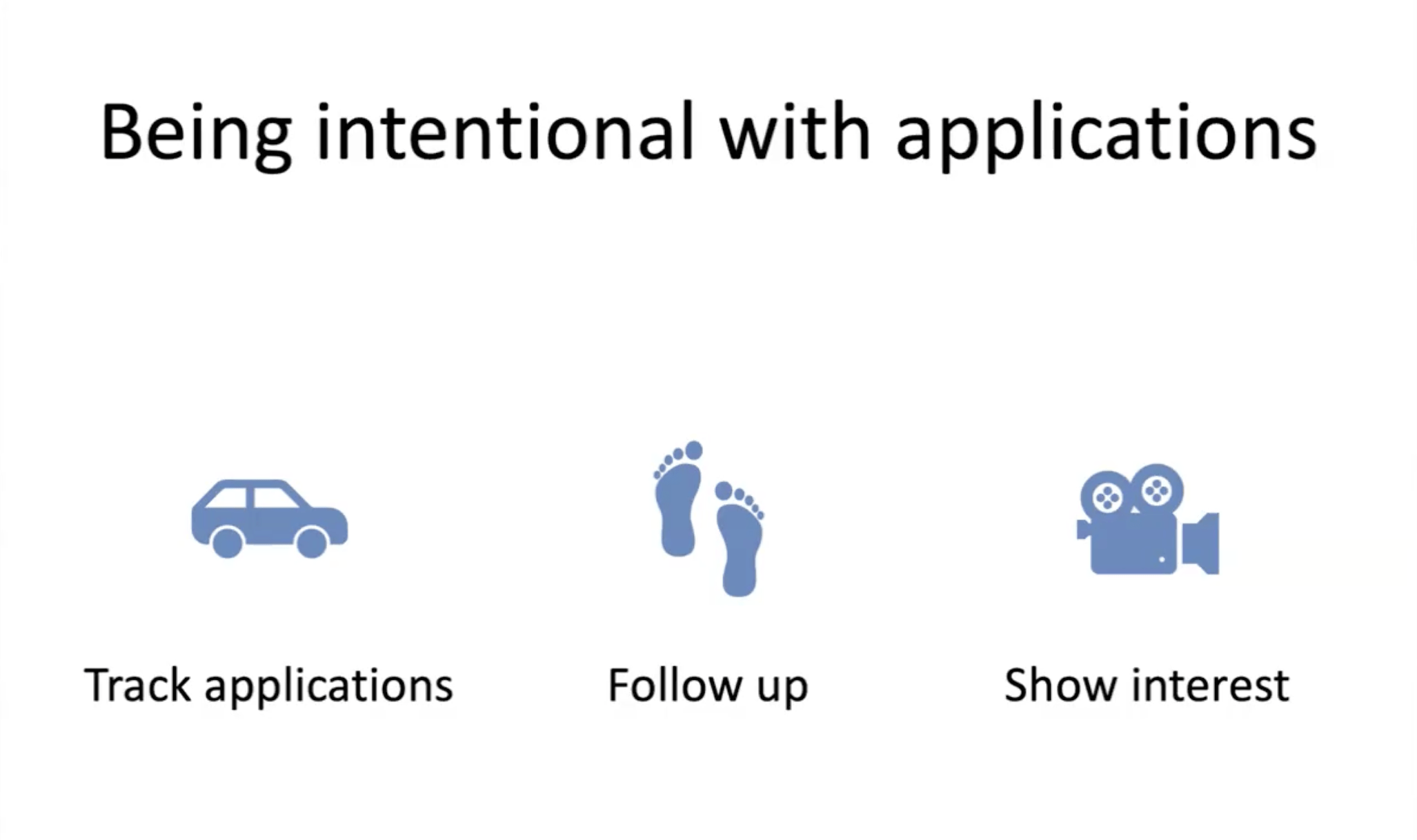
What I would suggest with regards to applications is again to be intentional. I speak to a lot of candidates and sometimes they’re not being very specific. Sometimes they’re just clicking ‘apply’ on every single data role that’s out there. What I would say is track your applications.
It takes two minutes: build a very basic spreadsheet, track the job title, the company, who the hiring manager was, a description and when you applied, and then follow up.
Post-interview
You’ve been through the interview process and perhaps you land that amazing job in analytics that you’re looking for. Perhaps you didn’t.
If you’re lucky enough to get feedback, the thing I would say is stay polite. It’s quite common that you think of something after the interview.
‘I wish I’d said that.’ ‘Why didn’t I say that?’ ‘I meant this.’ ‘They didn’t give me the full context.’
Obviously you wanted the role, but I’ve never seen arguing get someone where they want to be in this scenario.
The decision has been made, so my advice is stay polite and keep the relationship. There may be a situation, six months, 12 months down the line, when you want to reapply.
More likely than not your paths will cross again at another company and they’re going to remember how you left that interview process.
Homework
I’m going to close by giving you some homework. I invite you all to refine your one liner. Have a little think about what it is and how you hone in on it.
I invite you all to tailor your CV with AI.
I suggest that you ask for an endorsement.
And find one person you’ve mapped out in your network who would be good to connect with.
This content is for TGG Members
Join up today and get access to:
- All articles: news, interviews, analysis
- Masterclasses & Online Conferences
- Full Academy Productivity Rankings
- Club Directory: 1,000+ staff profiles
- Personal Profile Builder
- TGG Live 2024 & 2025 presentations