3v3 matches at the heart of radical grassroots changes in England
Written by
Ian Westbrook
April 7, 2026
Small-sided 3v3 matches and fewer 11v11 games are at the heart of radical changes planned for youngsters playing grassroots football in England from next season.
The new system, which will get under way in September following a two-year consultation by England Football, is designed to evolve the player pathway for children and to provide them with a better and more enjoyable playing experience.
Each of the existing playing formats will be moved back a year under the new system.
Under-sevens currently play 5v5 games, but they will move to 3v3 matches from September. The U8 and U9 age groups will play 5v5, the U10 and U11s seven-a-side, U12 and U13s 9v9 and then up to the full 11-a-side from U14s onwards.
England Football, which links up the game from grassroots football to the England national teams, undertook the two-year consultation process about the changes. Their work included a study into playing formats for youth players in other European countries – with both Belgium and Germany adopting a similar approach in recent years.
Working in partnership with Liverpool John Moores University, they studied more than 400 grassroots games from Under-6 to Under-14 level to enhance their understanding of how different formats affect young players both technically and physically and the impact the new set-up could make.
The changes planned for grassroots football in England next season will be explained and discussed at the Football Association’s online FutureFit: Digital Conference for clubs, coaches and volunteers on Monday 27 April.
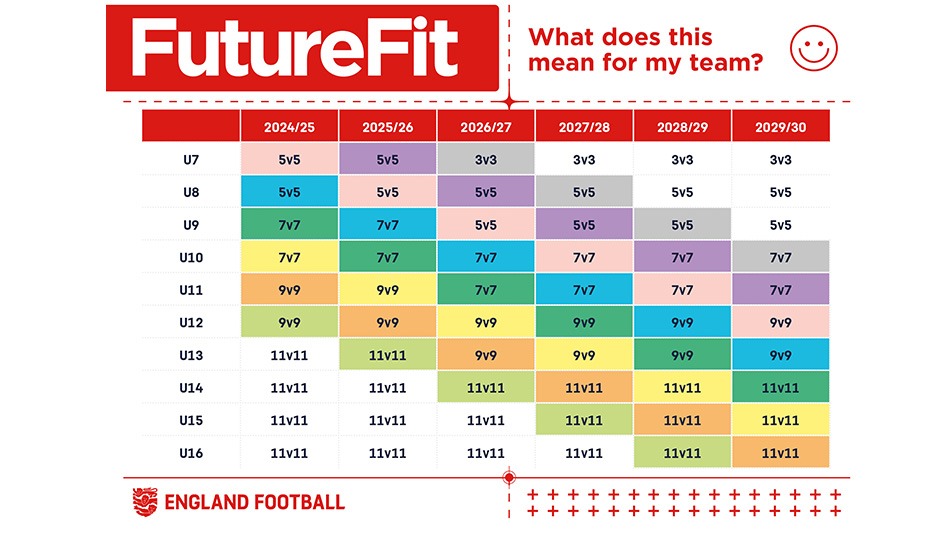
GRAPHIC CREDIT: ENGLAND FOOTBALL
Among the reasons for the changes, England Football say, are:
- The new 3v3 entry format will maximise engagement and provide the best introduction to football
- Greater alignment with schools with children playing smaller formats with simplified rules throughout primary school, before progressing to 9v9 and more complex rules at secondary school
- Evolved Laws of the Game that are age-appropriate and best support the overall development of the young player
Changes have already been made to the way Under-7 to Under-9 games restart to keep the ball in play for more time.
England Football’s Director of Development James Kendall said: “Our approach is about evolution, not revolution, helping to increase the levels of engagement, physical activity, skill development and the volume of technical actions for every player.
“Together with the County FA network, we are fully committed to working closely with all those involved in delivering grassroots youth football, providing the support needed to implement these changes across the country.”
One reason for playing small-sided games for longer is to ensure youngsters can get more involved in matches. England Football say: “Our ambition is to provide a safe, enjoyable and active game for every young player, every week, with increased physical activity and more touches of the football to improve their technical ability.”
‘Player-led approach the key’
After Belgium’s failure to progress beyond the first round of Euro 2000 – a tournament they jointly hosted with the Netherlands – the country’s coaching structure for youngsters was completely changed. As a result, they rose from 66th to first in the Fifa World Rankings by 2015.
Kris Van der Haegen, Belgium’s Director of Coach Education, told TGG in 2018: “One of the main principles is that the main actor is the player; not the coach, not the team. Then it’s very easy to understand that in children’s football we have to do what they like. We call it the tailor-made approach. Who is in front of me? Look at the characteristics of the player and then adapt the environment to fit them.
“Kids want to play football in their own way, not the way adults want to play. We ask them to play 11v11 or 8v8 at a very young age. They are not able to do it.”
Van der Haegen explained how they tailored the country’s grassroots set-up to fit in with the children’s abilities. The youngsters played in short small-sided games and then swapped pitches – the winners going one way and the losers the other. It meant that quickly each team was facing one of similar ability, which made it more enjoyable for everybody as all players were scoring and also winning games.
He is a big believer in letting youngsters get on with playing in their own way, adding: “Create the environment, free them and help only if it’s necessary. Let the kids discover – they are more intelligent than you think they are.”
Van der Haegen also emphasised that at the younger age groups, results were not the important thing – explaining that league tables were not produced until the Under-14 level in Belgium.
The system also looks after children who develop later than others – allowing them to drop down a year group if necessary to give them a chance to play in matches more suited to them.
‘Fun all-important’
New rules for Under-11s football in Germany came in during 2022 with emphasis on “fun and a player-centred approach”.
Ronny Zimmermann, Germany Football Association (DFB) Vice-President responsible for children’s and youth football, told TGG at the time: “We need to think like children, not like adults. Only children who develop fun and joy in the game will stay in football.”
The German plan’s key regulations are:
- Small-sided games
- Short playing times
- Players regularly rotated, with everyone involved
- No referees and minimal involvement from coaches and parents
- “Game afternoons” and festivals, rather than formal matches and leagues
- Heading practically eliminated
The rules came in after a two-year pilot phase with all of the country’s 21 regional associations, which received “very positive” feedback from children.
In a statement, the DFB said: “Playing with the ball and scoring goals are the main reasons why so many children and young people enjoy football. The new forms of play are intended to give all children on the pitch the opportunity as often as possible to have the ball at their feet themselves, to take an active part in the game, to score goals and thus to have a personal sense of achievement.”
England Football say that by attending their conference, clubs and coaches “will be better prepared to plan ahead, to support their volunteers and to ensure young players continue to enjoy a positive football experience”.
Registration for the conference can be made here.

This content is for TGG Members
Join up today and get access to:
- All articles: news, interviews, analysis
- Masterclasses & Online Conferences
- Full Academy Productivity Rankings
- Club Directory: 1,000+ staff profiles
- Personal Profile Builder
- TGG Live 2024 & 2025 presentations